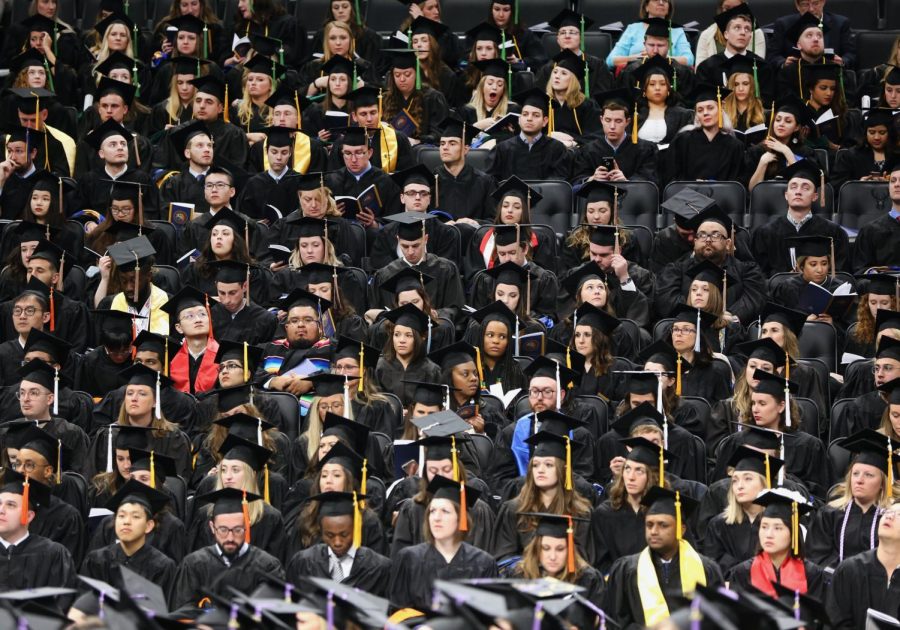

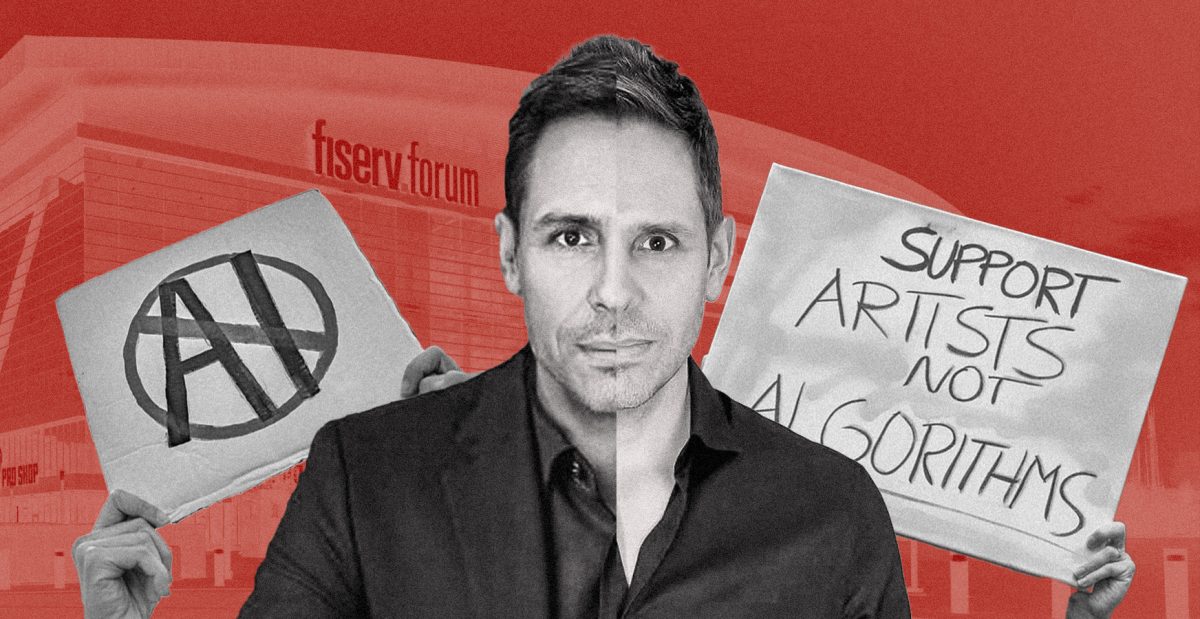
A number of Marquette University students simultaneously experienced a “slap in the face” Feb. 23 when the university announced Chris Duffey, alumnus and artificial intelligence leader, will be the 2026 commencement speaker.
Though Marquette has remained steadfast in its decision despite backlash, some students and alumni are voicing their concerns.
Tyler Hegdahl, a junior in the College of Business Administration, felt the decision goes against the university’s mantra of “being the difference.”
“When you choose someone like this, it’s so disappointing,” Hegdahl said.
Some students and alumni are disheartened about the decision; others are outright furious. The comment section under the commencement speaker announcement post on Marquette’s Instagram page — which features an AI-adapted photo of Duffey — is filled with over 200 accounts expressing disapproval.
Duffey is recognized as a pioneer in the design, strategy and standards of AI systems. He’s currently the global executive for AI and agentic systems at Adobe. His book, “Superhuman Innovation: Transforming Business with Artificial Intelligence,” was the first book about AI to have artificial intelligence as a co-author.
Students say selection contradicts Marquette’s Jesuit values
The university selected Duffy because his leadership in AI aligns with Marquette’s Catholic, Jesuit mission, university spokesperson Kevin Conway told the Marquette Wire.
Catholic, Jesuit teaching revolves around being “men and women for others,” and Marquette’s goal is to create students who are “transformed by their education and who will transform the world in which they live,” according to the university website.
Kiley Brockway, a senior in the College of Arts & Sciences, said she thinks the commencement speaker doesn’t encompass those values and even took her concerns to then-Acting Provost Sarah Feldner.
“It’s completely hypocritical of Jesuit values and the liberal arts education,” Brockway said.
Hegdahl called the decision a blow to Marquette’s reputation as a Jesuit university.
“The supposed belief of leadership and service; those missions seem performative now,” he said.
Ryan Smith, a sophomore in the College of Communication, said, if anything, AI is something Jesuit universities should be skeptical of.
“It’s pretty insulting to everyone graduating who had four years of higher education and worked hard and struggled, just to have their speaker be platforming AI,” Smith said.
Gigi Martin, a senior in the College of Arts & Sciences, feels especially let down, as she’s majoring in computer science — a field threatened by AI.
“It’s a tone-deaf choice from Marquette,” she said.
Marquette defends its stance
In the university announcement, Ah Yun said Duffey will bring a unique perspective to graduates entering an “unprecedented landscape of technological advancement and ethical dilemma.” He praised what he called Duffey’s ethical use of AI, saying it will inspire graduates to use the technology in a responsible way.
Conway said in a statement that speakers are nominated on the basis of their impact on society and engagement with Marquette.
Nominations for honorary degrees given to commencement speakers are reviewed by the Marquette University Committee on University Honors, which includes two students from Marquette University Student Government, Conway said. The committee then provides its recommendations to the Provost and President. The decision of who is eligible to receive an honorary degree is ultimately made by the Board of Trustees.
Some students pushing back
A number of students feel unsupported by the university’s lack of reception to their feedback.
The commencement speaker reveal is something students look forward to, Amy Henry, a senior in the College of Communication, said. This year, she said it led to disappointment.
“We’re the future workforce and so many of our careers are at risk from AI, and for our speaker to have a career in AI is appalling,” she said.
50-60% of entry-level job tasks can be executed by AI, according to Harvard Business Impact. Further, postings for entry-level jobs in the U.S. have dropped 35% since January 2023.
“There are tons of people who are super passionate and talented about to graduate, so it felt like a slap in the face to see that the school chose a leader in AI to give a speech to us,” Erin Cavender, a senior in the College of Communication, said.
Feelings of misrepresentation
Several students said the choice doesn’t accurately reflect how students and professors feel about AI in higher education.
Marquette hasn’t published a university-wide policy on AI, leaving each professor to decide their own guidelines.
“[Professors] say not to use it, but the commencement speaker is actively promoting it for the last decade,” Hegdahl said.
Students see a contradiction between how AI is penalized in the classroom yet is at the forefront of Duffey’s career. Some students find the university’s decision a hard pill to swallow.
“AI is a wonderful tool that’s going to help the world, but it has no place in higher education because it diminishes the value of the school itself,” Kian Howe, a senior in the College of Arts & Sciences, said.
Higher education institutions around the nation have grappled with AI usage in the classroom, and a number of Marquette students hope the university will create a clear policy.
Others feel fatigued hearing about the topic on a daily basis.
“I feel like there is so much more we can talk about instead of AI over and over again,” Brockway said.
A commencement speaker choice is a statement, Brockway said. She hopes Marquette administration has a better idea of where the student body stands in future decisions.
Brockway thinks the next step should be open dialogue so university administrators understand how students want to be represented.
“We’re told to be the good we want to see in the world; to resist harm and not fold within it,” she said. “If we’re living by what Marquette has taught us, that comes with using our voice.”
This story was written by Elena Metinidis. She can be reached at [email protected].
This story has been updated for clarity.