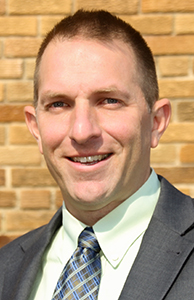


At his apartment near Seventh Street and Wisconsin Avenue, Tony Everard spends the end of March no differently than many college students across the country. He fills out NCAA men’s basketball tournament brackets and watches March Madness games, eagerly awaiting the next upset.
But Everard isn’t like most college students — and he watches the tournament his own way.
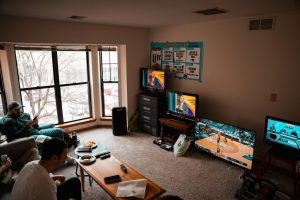
The 33-year-old Ph.D. student has four televisions facing his couch, and he watches them all while guarding an army of remote controls on his coffee table. To an untrained eye, the remotes would look nearly identical. But Everard keeps track of them all.
One remote has buttons that stick. That remote goes to TV No. 3, which hosts what Everard deems the third-best game on air. It is often a high seed against a low seed, games which many analysts declare over before they start.
“It’s good to look at the schedule for each TV window to prep and see what games you want,” he said.
Another remote is a bit thicker and heftier than the rest. That one matches with the primary TV. The 56-inch flatscreen, which sits on the floor, commands the best game, the closest game or the game with a fan in the room.
As guests walk through Everard’s door, most of them arrive with loyalties. Over the years, friends from undergraduate and graduate school have fixated on TV No. 1 to watch their alma maters from across the country play. In 2026, Everard put Clemson, Miami (Ohio) and Wisconsin on the big screen for his affiliated guests.
Of the 64 teams in the first round of the 2026 NCAA Tournament, Everard said he has friends that graduated from, attend or work for 41 of them. From national champion favorites like Duke and Arizona to lower seeds such as Furman or Long Island, he holds a connection to nearly every game on the screen. And the screen beside it. And the screens next to them.
When those connections aren’t in his living room, they’re still there in spirit. On opening night of the Round of 64, the St. Mary’s Gaels battled the Texas A&M Aggies. Everard texted back and forth with friends from both schools.
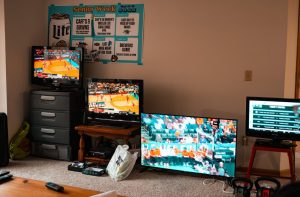
But midway through his first day of hosting, March 19, the Ph.D. student in the College of Business Administration panned over his control room. His last guest had left, and as he prepared for the next wave of visitors, he leaned back into the couch and said, “I’m very lucky to be sitting here.”
Ten years ago, Everard was enjoying the final semester of his undergraduate career at Marquette. He was studying for the Graduate Management Admission Test while fervently participating in club and intramural basketball.
Shortly after, he was preparing for his second heart surgery in four months. And as he was readying to face the anesthesia, Everard said seven words to the doctors:
“If you kill me, you kill me.”

Midway through the Fall 2016 semester, Everard came down with an illness. Barely able to eat or drink, he was given antibiotics to no avail, ultimately needing surgery to get his tonsils removed.
While getting ready for the procedure, Everard took an electrocardiogram test to monitor his heart activity. The anesthesiologist told him there was something wrong and encouraged him to go for further testing after healing from his surgery.
The results showed he was born with a heart condition. He went in for surgery in January 2017.
“I basically put my life on hold,” he said.
With Wolff-Parkinson-White syndrome, Everard had a second electrical pathway in his heart, which sent extra signals between the heart’s upper and lower chambers. The surge would often kick his heart into overdrive, causing an elevated heart rate. Over 99% of WPW cases are non-life threatening.
But after eight hours in surgery, doctors discovered Everard had been in the other 1%. He was within the death risk — in any of his basketball games, he could have collapsed on the court.
“’You are damn lucky to be alive,’” Everard recalled doctors telling him.
Months after the surgery, he stepped onto a court again to play basketball, testing if his heart could handle the activity. His heart rate reached 250 beats per minute before he took off his monitor to play for another hour. Though he was unaffected by his heart rate, it was a signal that there was still work to be done.
So, Everard went in for a second surgery — which came with an added risk. The procedure involved the burning of the extra electrical pathway, which surgeons did not complete during the first operation after nearly putting a hole in Everard’s heart. But, not wanting to live a limited life, he wanted to have the procedure anyway.
“I had to tell my parents goodbye,” Everard said. “When you’re 22, 23, telling your parents that — you grow up fast.”
Following the surgery, Everard spent a year undergoing testing to make sure his heart was functioning properly. Then, he went back to school to get his master’s degree. And the lifelong Wisconsinite returned to the school he once called home: Marquette.
Now, MBA in hand, Everard is pursuing a Ph.D. in business, researching the effects of mobile ticketing on consumers at sporting events. And he’s doing it with ten years’ worth of perspective.
“I have a different outlook on life than most people,” he said. “When you’re crying yourself to sleep, like, ‘Am I gonna live? Am I gonna live a normal life? Am I gonna live a long life?’ — no one at a young age should have to consider that.”
While pushing for his Ph.D., Everard also runs his own business: Ticket Professor LLC. In addition to studying ticketing, he also sells them and is a consultant for ticket brokers.
His work and research have allowed him to watch live sports from coast to coast, attending the College Football Playoff, scouting teams for the Pop-Tarts and Citrus Bowls and stopping at March Madness games across the country.
But in 2026, as he does most years, Everard watched the first round in full from his own apartment, surrounded by friends.
Everard’s door swings open throughout the day, as guests come and go to watch the games while talking about basketball, life and stories from years past. Some have known him since grade school, others he befriended during his first stint at Marquette and others have become close friends during graduate school.
Despite their variance in connection, they share the same focus, watching the games under Everard’s meticulous planning. Just as the teams on the court have depth charts, he has his own in the living room, moving games to and from TVs depending on their magnitude. If a game comes down to the wire, it gets promoted to a bigger screen. If it’s a blowout, it gets relegated to the corner.
But the planning doesn’t stop at the screen. Prior to the opening weekend of March Madness, Everard bought six pounds of chicken wings to serve — a more-cost efficient way to feed his friends than takeout. He also bought tamales and chips with salsa, which he said he knew his visitors would like.
Alex Grych, a 2016 graduate from the College of Business Administration, met Everard in 2011 on their floor in Mashuda Hall. The two have stayed in touch ever since, and Grych made sure to stop by for one final March Madness before moving to New York next month.
“Tony’s probably the most passionate sports fan I’ve ever met.” Grych said. “Nobody is even remotely close to the setup he has.”
Jake Dufresne met Everard playing baseball in Madison. The University of Wisconsin-Madison graduate moved to Milwaukee two years ago, and, like Grych, has kept in touch with Everard
“Pretty much all we do, whenever we text, it’s about college sports,” Dufresne said. “Tony’s just a good friend to have.”
Everard stays in touch with as many people as he can. His network, in all its expanse, comes with perks. When he travels for his ticketing adventures, he has a friend to stay with in nearly every major city.
It’s that commitment to friendship and connection that, for many, makes Everard an anchor for March Madness every year. The four TVs, chicken wings and beverage refrigerator all greet guests at the door, along with an open seat in the living room.
The watch parties’ purpose is threefold for Everard. He gets to watch basketball, spend time with friends and save them the expense of going to restaurants and bars to watch the games. Naturally, he spent the days leading up to the tournament texting as many friends, students and even neighbors as he could, inviting them to experience the madness together.
For Everard, gathering with friends is a reminder that life — in all its preciousness and unpredictability — means the most when it’s spent with others.
When sitting around the living room, the group often throws out statistics, like shooting percentages and offensive efficiency. After all, with Everard’s background analyzing business, tickets and sports, he has learned how to interpret data.
But despite his experience crunching numbers, he doesn’t always listen to what they say — even when the odds are stacked against him.
“I’m lucky,” he said.
This story was written by Lance Schulteis. He can be reached at [email protected].