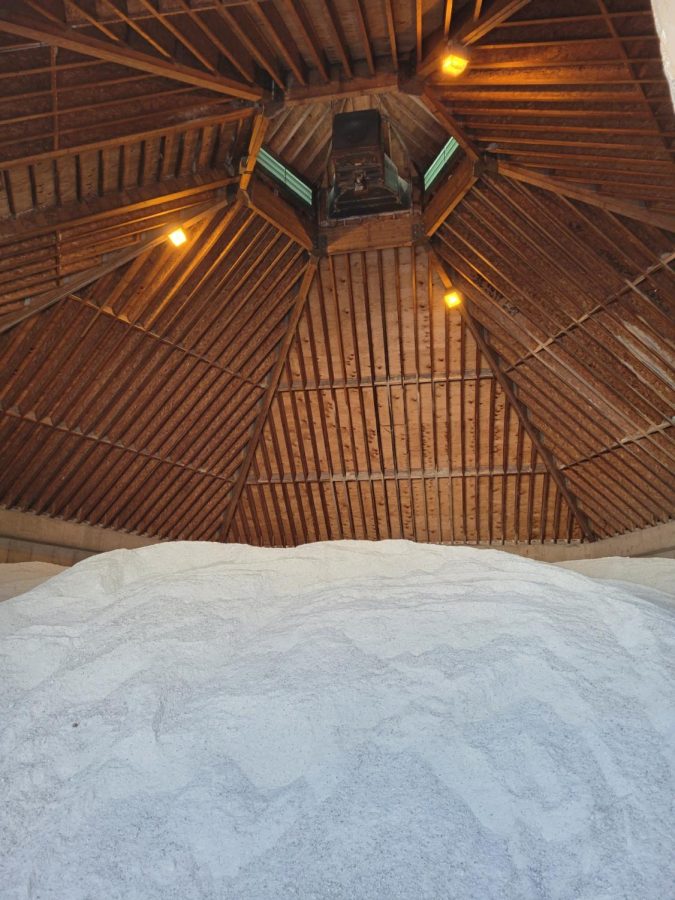


Year after year, Milwaukee is hit with snowy and icy winters that temporarily send the city into disarray — slush-covered roads, skidding cars and slippery sidewalks adding difficulties to daily commutes. The city responds with plows and road salt to make driving conditions more manageable, but there’s a cost to clearing the roads.
This winter, Milwaukee has experienced over 40 accumulated inches of snowfall throughout the season, with the highest snowfall occurring on Nov. 29.
The key element in road salt, chloride, is harmful to freshwater and the environment. When snow and ice melt and mix with the salt, the brine flows into Milwaukee’s freshwater sources and pollutes them with the chemical.
The Wisconsin DNR monitors chloride levels in Wisconsin’s rivers and has found that long-term quality trends are showing increases in chloride, with 50 rivers and a lake in the state having been affected by large concentrations of the chemical.
It takes one teaspoon of salt to make five gallons of water toxic to native aquatic ecosystems, according to Wisconsin Salt Wise. As of 2023, the Department of Public Works used over 35,000 tons of salt annually on roads in the winter.
The Marquette Wire reached out to the campus facilities department about the use of road salt on the university’s campus and did not receive a response.
David Strifling, associate professor of law and director of Marquette’s Water Law & Policy Initiative, said the university signed a pledge in 2015 that symbolized a commitment to caring for the earth — the Saint Francis Pledge, developed by the U.S. Catholic Bishops. The pledge emphasizes a moral responsibility to take part in preventing climate change through sustainable living.
“Reducing salt use could be one aspect of this,” Strifling told the Wire in an email.
He explained that liquid brine — which Marquette often uses in place of rock salt — is used to pre-treat travel surfaces before winter weather and uses less salt than the road salt that is typically used.
The Milwaukee County Department of Transportation Highway Maintenance Division also uses brine to pretreat roads before snowfall and are partnered with Salt Wise to receive annual training on strategies to reduce salt use.
The Conservation Foundation, an Illinois-based nonprofit dedicated to environmental preservation, says brine is a better alternative because of its water content, which allows it to stick to the pavement and stop snow from binding to the road. Brine is 23% rock salt, meaning it uses less salt on roads compared to rock salt alone.
Legal regulation and responsibility are murky when it comes to salt use, Sarah Fox, associate professor of law, said.
Fox said it’s easier to monitor point source pollution — contamination from a singular entity or location. But, she said, non-point source pollution — which includes anything that comes from excess runoff of residential and agricultural material such as fertilizers and road salt — is harder to navigate because of the lack of a single source.
“If private institutions like Marquette wanted to, they could impose self-regulation on salt use,” Fox said.
Shannon Haydin, storm water section manager for the Wisconsin Department of Natural Resources, said in an email to the Wire that road salt is likely the highest contributor to non-point source pollution in urban areas. She added that elevated chloride levels in freshwater are causing some waterways in the Milwaukee area to become increasingly high in salt content.
“Salt is a ‘forever chemical,'” Haydin said in an email. “There are no best management practices that can remove the salt without a significant investment in money.”
Desalination, the process of removing salt from water to make it drinkable, is costly both financially and environmentally. A plant can cost millions of dollars to build, requires large amounts of energy and produces a waste product with a higher salt content than the water prior to its treatment.
Fox believes most of the responsibility for environmental protection falls on federal and state government agencies, which have the most control over water quality laws.
“They might be able to impose more stringent standards about non-point source pollution and runoff,” she said.
Similarly, Strifling said placing legal responsibility on private corporations for salt use is unlikely, so long as the salt is serving its intended purpose.
“Road salt never goes away,” Haydin said in an email. “There is nothing that will break it down and eliminate it from the environment.”
This story was written by Lilly Peacock. She can be reached at [email protected].