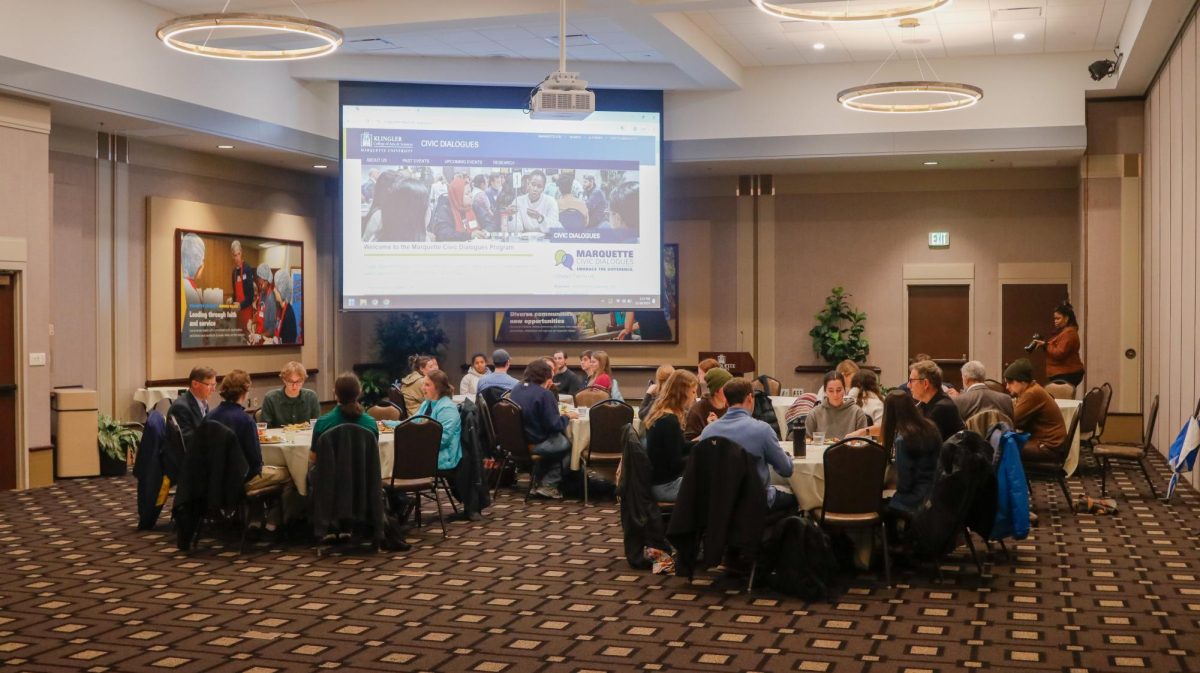

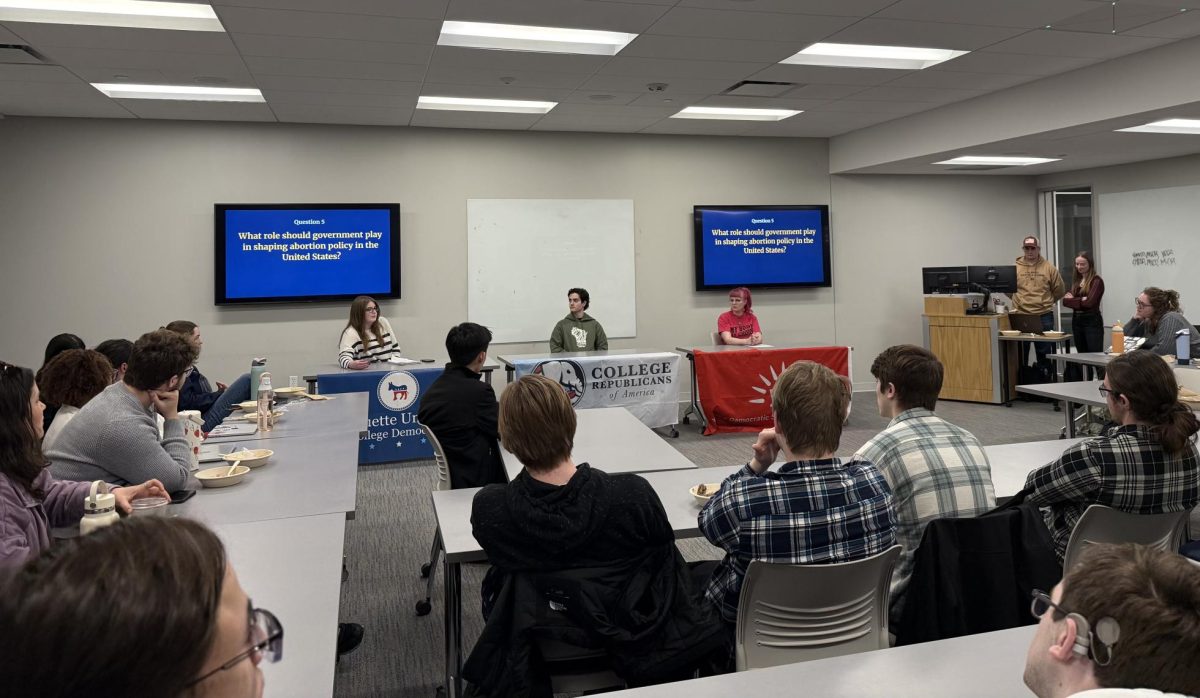
Three of Marquette University’s political student groups came together the evening of Feb. 19 to converse about gun rights, abortion rights, artificial intelligence and immigration policies without debating amongst each other.
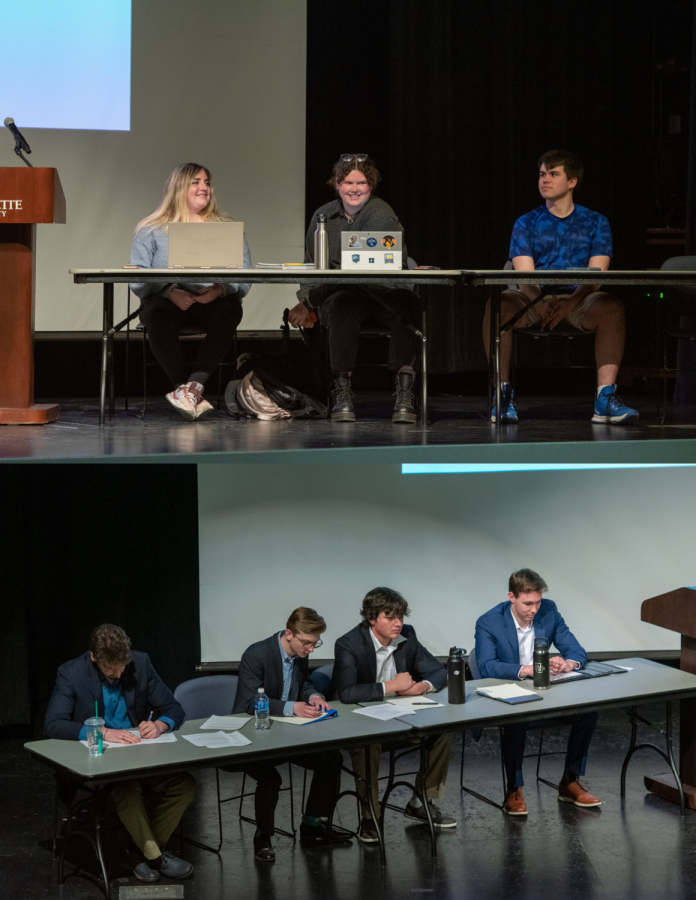
College Republicans, Marquette’s Young Democratic Socialists of America chapter and the College Democrats shared their thoughts on six previously agreed upon political topics at an event in O’Brien Hall deemed “Dialogue Night.”
The structured nature of the event, organized by Elliot Sgrignuoli, head of the College Republicans, allowed for one representative in each group to give an answer per question.
Each representative was given a fixed three-minute speaking time, moderated by the executive boards or steering committees of each organization. Speakers were allowed notes while presenting their arguments.
“It’s trying to get a taste of the different ideologies that exist on campus and giving people the opportunity to speak their mind and show their passion, to a reasonable degree,” Natalie Gazzana, a junior in the College of Arts & Sciences and chair of the College Democrats, said.
The goal of this event was to get individuals out of their echo chambers, the heads of the three organizations said. Despite this, some attendees exchanged loaded glances, whispers and laughs as participants of opposing organizations spoke about the most contentious topics, namely abortion rights, gun laws and immigration policies.
It was firmly established that the dialogue was not a debate, and there would be no space for rebuttals of any kind. Instead, the intended outcome of the event was to foster conversations between individuals.
“The process for me is really about humanizing one another,” Alannah Gallagher, a sophomore in the College of Arts & Sciences and head of YDSA Marquette, said.
The previously agreed-upon questions were:
- What does America look like in 10 years?
- How should Americans think about affordability?
- How will artificial intelligence impact the 2026 election and beyond?
- How do we address gun violence in and toward schools?
- What role should government play in shaping abortion policy in the United States?
- Is current immigration policy sufficient or too extreme?
After representatives answered the six questions, the floor opened up allowing attendees to talk amongst themselves and digest what was discussed.
“I hope we’re in a place where we can actually have real productive conversations,” Elliot Sgrignuoli, a senior in the College of Arts & Sciences, said in response to the question about what America will look like in 10 years. “We need to get America working together.”
When Sgrignuoli first thought to have “Dialogue Night,” he only had plans for it to remain within his organization.
Leading up to the 2024 presidential election, the three groups attempted to schedule a dialogue, but due to scheduling conflicts and miscommunication, Sgrignuoli said, the idea never took hold.
Now, Gazzana said, the student organizations were excited for the opportunity to collaborate with the other groups.
For YDSA Marquette, which officially became a campus organization at the end of spring 2025, “Dialogue Night” served as an opportunity to introduce socialism to the campus political space.
Gallagher said YDSA thinks of themselves as an organization rather than a party, focusing on grassroots campus organization and policies.
“What we’re seeing right now in the wider political context is the process of dehumanization, and not just amongst political ideologies,” Gallagher said. “It becomes very easy to stop seeing each other as actual people, unless you can sit down and talk with one another.”
The forum also allowed participants to share the human side of political issues. For example, Alivia Allen, a sophomore in the College of Arts & Sciences and member of College Democrats, spoke about her experience as a student at the 2023 Milwaukee Lutheran High School shooting.
“This is an issue that’s extremely personal to me,” she said.
Marquette already hosts civic dialogues — structured conversations facilitated by moderators. At these events, Sgrignuoli found that tables are usually dominated by one person, knowledgeable and excited about the topic, while the other participants are only there to get the extra credit points their professors promised.
“What we’re doing [with Dialogue Night], you’re getting people who already care about politics, which means coming in with more knowledge,” Sgrignuoli said. “It’s going to challenge your current ideas.”
After the cross-organizational event, Sgrignuoli is looking to the future — specifically the 2026 midterm elections — and said he hopes the clubs can continue growing and continuing the conversation. Gazzana and Gallagher share that sentiment.
“Our doors are always open for any involvement from either of the clubs,” she said.
This story was written by Mina Marsolek-Bonnet. She can be reached at [email protected]. Sahil Gupta contributed to this report.