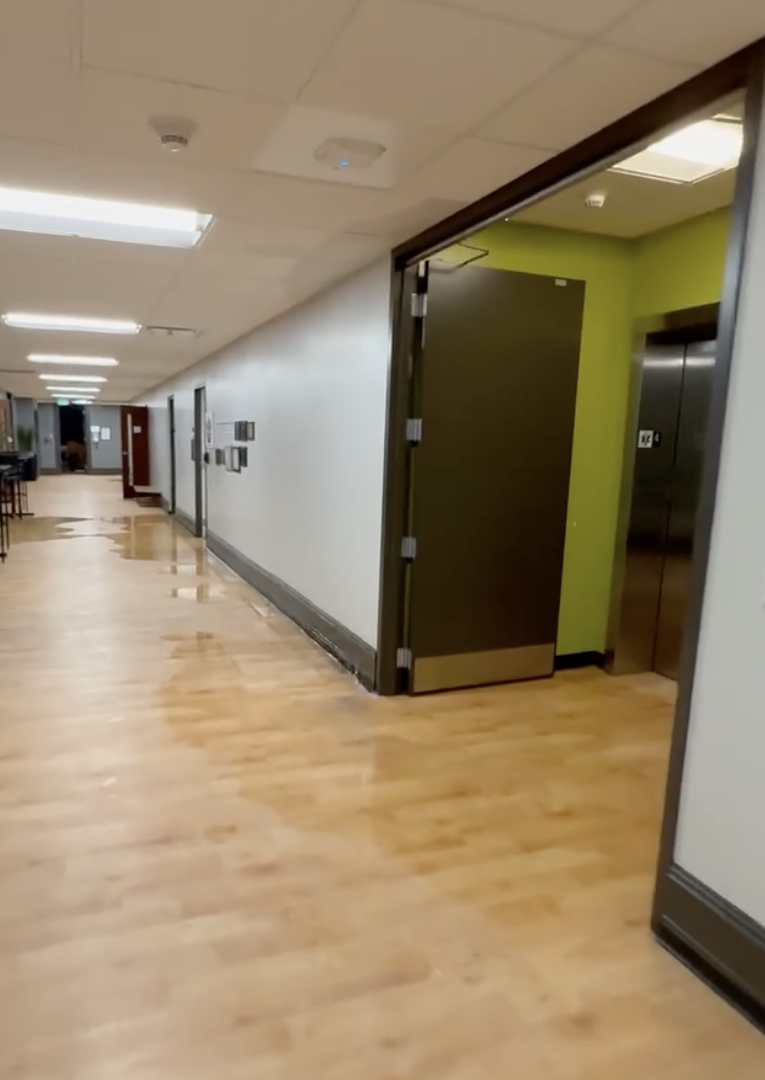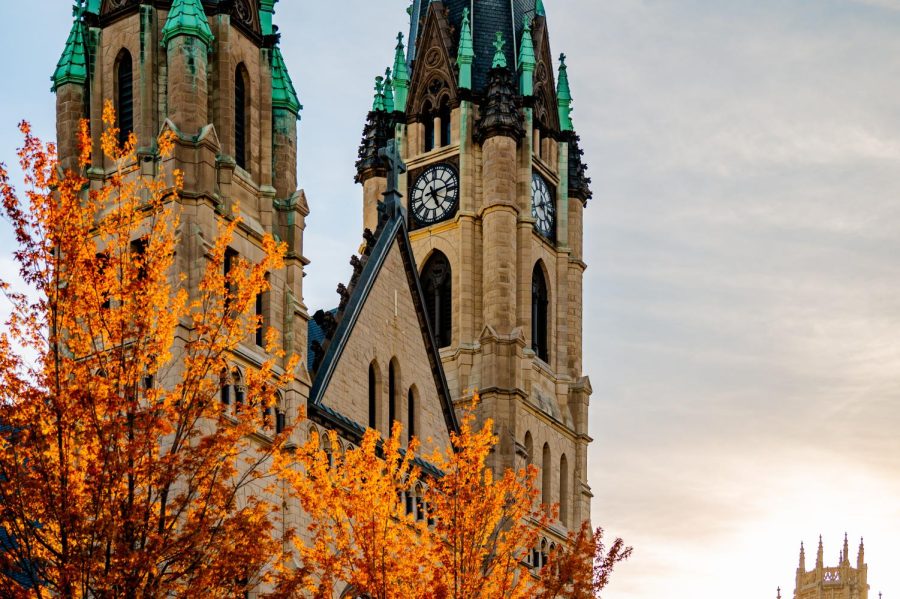


After a weekend stamped by a building-wide flood, Johnston Hall closed from Feb. 2 to Feb. 6, canceling in-person classes. The following week, the building reopened — though with a few new additions since students last walked the hallways.
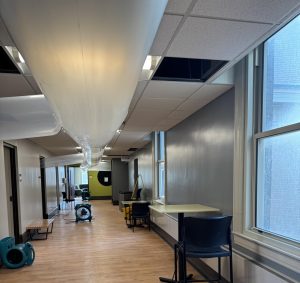
Fans set to maximum amps sit as fixtures on the floor, whirring in the background of lectures. Ceilings look like checkerboards with over 100 missing tiles, revealing the vents and pipes above. Contractors roam the building while continuing to fix the damage on floors above.
Here’s everything that happened since the flooding first started.
Saturday, Jan. 31
4:30 p.m.
Mike Jahner, director of facilities management, said his team was notified of a flood by the Marquette University Police Department.
5 p.m.
Facilities staff arrived at Johnston Hall to assess the flooding. The first step was to locate the source and stop the leak, but Jahner said the task proved harder than just following the water trail.
Water poured from the ceiling near two stairwells on opposite sides of the building. Unlike most newer buildings where water will level in a single location, Jahner said, the floors in 118-year-old Johnston Hall aren’t perfectly even, causing water to pool in more than one spot.
With more standing water on each ascending floor, the fifth floor became the focus. Facilities services then narrowed its search to the Johnston Hall attic, which is only accessible through a fifth-floor crawl space and has a catwalk-like layout, Jahner said.
However, even after checking the attic, the team was still unable to locate the leak. Jahner was not on campus, instead lending his expertise after being sent photos and videos.
Still, the source of the leak wasn’t found.
“The pictures I was getting, it wasn’t making sense,” Jahner said.
So, Jahner went to Johnston Hall to investigate in-person.
5:30 p.m.
With water still pouring down, Kati Berg, acting dean of the College of Communication, first received word of the flood from faculty over text. Berg was out of town at her daughter’s basketball tournament and didn’t have her computer on hand, so she had to manage the flood response on her cell phone.
“We had just sat down to have dinner with the team,” Berg said. “And then I got videos of the water coming through faculty offices.”
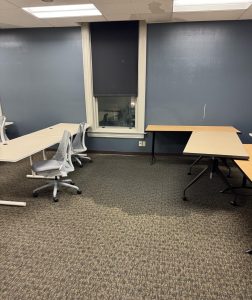
Berg got to work, calling faculty with offices on the fifth floor where the water was at its deepest. Among them was Larry Zhiming Xu, an assistant professor in the College of Communication who works out of Room 530 — right next to the still-unknown source of the flood.
Water destroyed the drywall in his office, pouring out of the ceiling like a showerhead and creeping through walls before trickling to the floor.
Xu said faculty in the college often joke about him being a minimalist, which ultimately worked in his favor.
“In this case, it helps,” Xu said. “If you don’t have much stuff in your office, nothing can be destroyed.”
6:30 p.m.
Once Jahner decided to check on Johnston Hall in-person, facilities services finally put a stop to the waterfall, though not in the way it initially wanted.
“We ended up just shutting the water off in the building,” Jahner said. “Generally, we try to avoid doing that only because we don’t want to shut the heat off for the building, too. Once you shut the water off, you lose heat.”
With the water shut off, the team finally located the culprit of the leak: a half-inch split in a copper pipe that was ¾ of an inch thick. The pipe was tucked away in a corner of the attic, frozen by the January air.
Not only was the pipe obscured from view, but it was also hidden from the building plans. The pipe, Jahner said, was a domestic water line that was no longer in use.
“We didn’t even know it was there,” Jahner said.
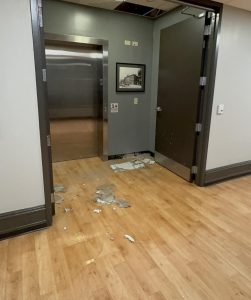
With the source of the leak shut off, the flood assessment began. The facilities services team opened the doors to every classroom and office in the building, wading through water that covered their feet to determine the extent of the damage.
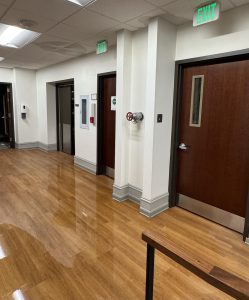
Water pooled on every floor, ceiling tiles caved in under their own weight and crashed to the ground and offices — including Xu’s — had fallen into disrepair.
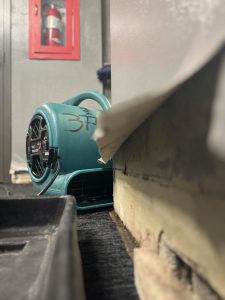
With the flood stopped and standing water left in its wake, facilities services rushed to get the water cleaned up as quickly as possible. However, Marquette did it with the help of a contractor, which was already on campus to repair a broken pipe in the Alumni Memorial Union.
Due to the age of the building, most of the walls in Johnston Hall are made of plaster rather than drywall. As a result, the fans were positioned to dry out the water that would have otherwise stayed in the wall. Jahner said baseboards were pulled off of the walls and fans were blown upwards to dry the plaster.
The following morning, the contractor brought a dehumidifier system on a truck to flush the moisture out of the building. Heavy-duty fans filled the upper floors while plastic tubes ran across the ceiling and through each room for ventilation.
Sunday, Feb. 1
2:04 p.m.
Less than 24 hours after the leak sprung, Berg sent out a statement that Johnston Hall would be fully closed for a week. Anyone needing access to the building would need to coordinate with Berg and MUPD and swipe access to the building were disabled.
The statement instructed students to prepare for virtual classes, though some professors worked with the Registrar’s Office to move their classes to other buildings. Among them were theater classes that relocated to the Helfaer Theatre.
“I appreciated how quickly the university and also the college were reacting, to inform us and to actually develop an action plan,” Xu said.
At the time, there was no estimate for reopening, though Johnston Hall was expected to be closed for “at least a week.”
Monday, Feb. 2
8:30 a.m. and 3 p.m.
Berg and other College of Communication faculty went into the building to gather any necessary materials from their offices to prepare for a week of remote learning. As part of the recovery effort, Berg asked Xu the day prior if there were any valuables in his office he would like to have cleared out.
“The only thing that is valuable would be my diplomas,” Xu told her.
The diplomas happened to be on the wall opposite the damage, and Berg was able to take them off the wall, dry, safe and sound.
Tuesday, Feb. 3
2 p.m.
Xu and his Johnston Hall neighbor, Virginia Sánchez, assistant professor in the College of Communication, relocated to new, temporary offices on the fourth floor. The two cleared out all of their belongings, which included waterlogged books and papers.
To the beat of humming fans and dehumidifiers, their offices were packed onto carts and transported a floor below for the indefinite future.
“The day that I was packing up in that office, [I could] see the damage, which is pretty sad and heartbreaking,” Xu said.
Wednesday, Feb. 4
4:33 p.m.
Berg sent out a second email to College of Communication students, faculty and staff, saying the building would reopen sooner than expected. While classes remained online for the week, the second floor, first floor and basement reopened the following day, Feb. 5.
The third, fourth and most of the fifth floor needed a few extra days to dry, but reopened Feb. 9.
Flooding aftermath
Four rooms on the fifth floor, including Xu’s office, will be closed long-term to address the damages. That grouping includes two additional offices and a conference room, which Berg said will likely need a new screen and projector.
However, the damage was minimal compared to Berg’s biggest worry, which was damage to video and audio equipment on the second floor. After the cleanup, the equipment was marked safe, and the building was deemed habitable for classes.
“We have great team of people across the university,” Berg said. “We made it work, but it was a little stressful.”
Jahner said the university does not yet know the total cost of the cleanup.
This story was written by Lance Schulteis. He can be reached at [email protected].