

Abraham Lincoln, the 16th president of the United States, is often immortalized by two famous speeches: The Gettysburg Address and Emancipation Proclamation. But among Lincoln’s catalog of vocal performances is a speech that he gave in Milwaukee, just over a year before he won a seat in the White House.
Before Lincoln ran for president, abolished slavery in the U.S. and graced the penny, he stepped onto a platform on what is now Marquette University’s campus. At the 1859 Wisconsin State Agricultural Fair — 21 years before Marquette opened its doors — Lincoln addressed a crowd at what is now 12th Street and Wisconsin Avenue, clean-shaven and largely unknown.
With his 1860 presidential campaign still a few months away, Lincoln’s appearance at the fair was one of his last before his name went down in history — the Milwaukee Sentinel reported the address as given by “Abram Lincoln.”
In what the Daily News called a “stentorian voice,” Lincoln took to the Brockway fairgrounds and addressed the “mudsill theory” of mid-1800s American politics. James H. Hammond, a South Carolina senator, coined the theory to affirm slavery, claiming that the United States depended on a social structure with a lower class for stability.
“That’s what got Lincoln roused up into politics — to argue otherwise,” Orville Vernon Burton, a historian and author of “The Age of Lincoln,” said.
In his address, Lincoln countered the idea of laboring classes in the United States. Instead, he laid out his preference for a different social order, based on free labor, education and the pursuit of knowledge.
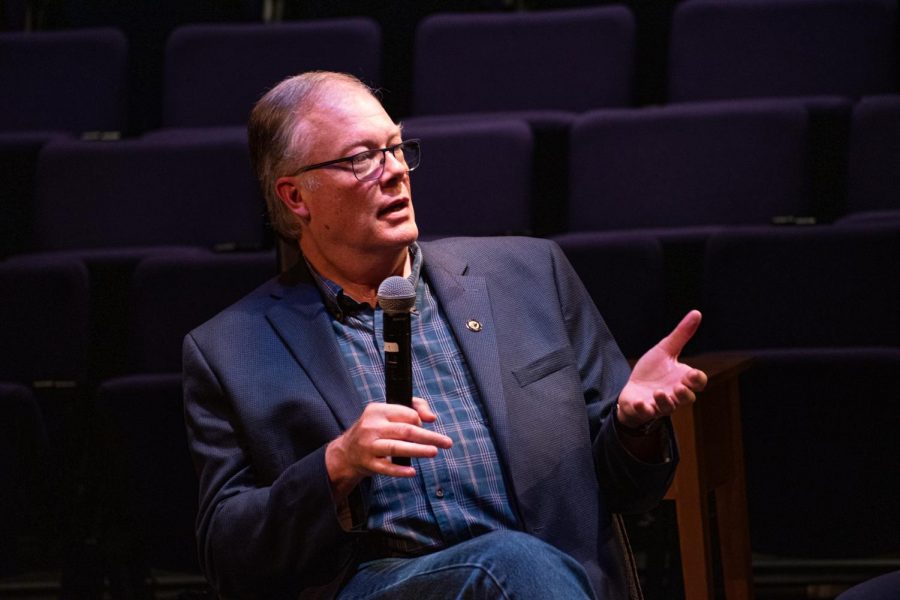
Dan Blinka, a professor of law at Marquette, described Lincoln’s approach to social issues, including slavery, as based on “human improvement.”
“Lincoln rejects mudsill theory and believes in moral uplift,” Blinka said.
The “mudsill speech” lasted for around an hour. Within earshot were masses of students and teachers, who were released from Milwaukee schools to attend the fair on a Friday afternoon, only to hear from a future president in the process.
“Let us hope, rather, that by the best cultivation of the physical world, beneath and around us; and the intellectual and moral world within us, we shall secure an individual, social and political prosperity and happiness,” Lincoln said in his closing remarks.
And after Lincoln stepped his 6-foot-4 frame off the platform, he slipped back into the crowd. In his final months before eternal fame, “Abram” spent his hours in Milwaukee as did every other attendee at the Wisconsin State Agricultural Fair, reveling in the festival’s races and fireman’s parade.
“Mr. Lincoln was royally entertained that afternoon,” J.E. Moriarty wrote for the Milwaukee Free Press in the early 1900s. “It is said he enjoyed the attractions as much as any man at the fair.”
The speech and trip would be Lincoln’s last in Milwaukee, as Wisconsin’s support for the abolition of slavery meant he didn’t need to target the Badger State on the campaign trail. Lincoln and the fairgrounds went their separate ways, but over 165 years later, a small, engraved plaque stands in his place.
Surrounded by bushes on the corner of 13th Street and Wells Street, the marker lists Abraham — not Abram — Lincoln’s name larger than any other word on the tablet. But just above the serif-printed name read the words, “near this spot.”
In the years since 1859, the Brockway Fairgrounds land, once Milwaukee’s city limit, has added streets, buildings and a university. So, even though Lincoln is memorialized just outside Schroeder Hall, the exact ground where he stood has been lost to history.
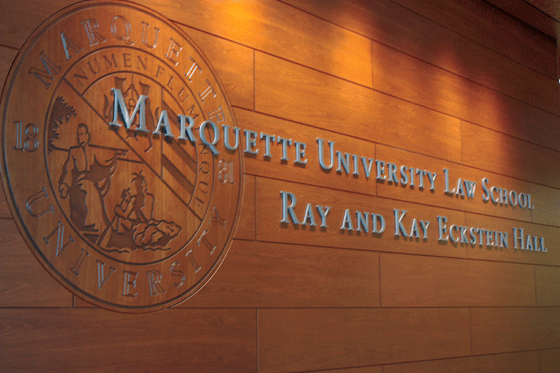
In 2009, 150 years after the speech, the Marquette University Law School celebrated Lincoln with a commission, which organized commemorative meetings and events. The commission’s keynote speaker was Burton, a then-emeritus professor of history at the University of Illinois and winner of the Chicago Tribune’s Heartland Literary Award for Nonfiction with his book, “The Age of Lincoln.”
Among Burton’s other works, he compiled in 2009 “The Essential Lincoln,” a collection of what he deemed to be Lincoln’s 29 most significant speeches and correspondences. Burton placed Lincoln’s Wisconsin speech within the same ranks as the Gettysburg Address and Emancipation Proclamation.
“It’s one of his defining speeches of all time,” Burton said.
And while the physical reminder of that speech sits just a foot above the ground, some say Lincoln’s words still linger in the air.
Burton said Lincoln’s speech remains applicable by calling out classism in American society — breaking down walls between the elite and the other side of the mudsill. Lincoln’s push for education, Blinka said, is a call for critical thinking in an era captivated by artificial intelligence.
“That’s as current now in 2026 as it was in 1859,” Blinka said.
This story was written by Lance Schulteis. He can be reached at [email protected].