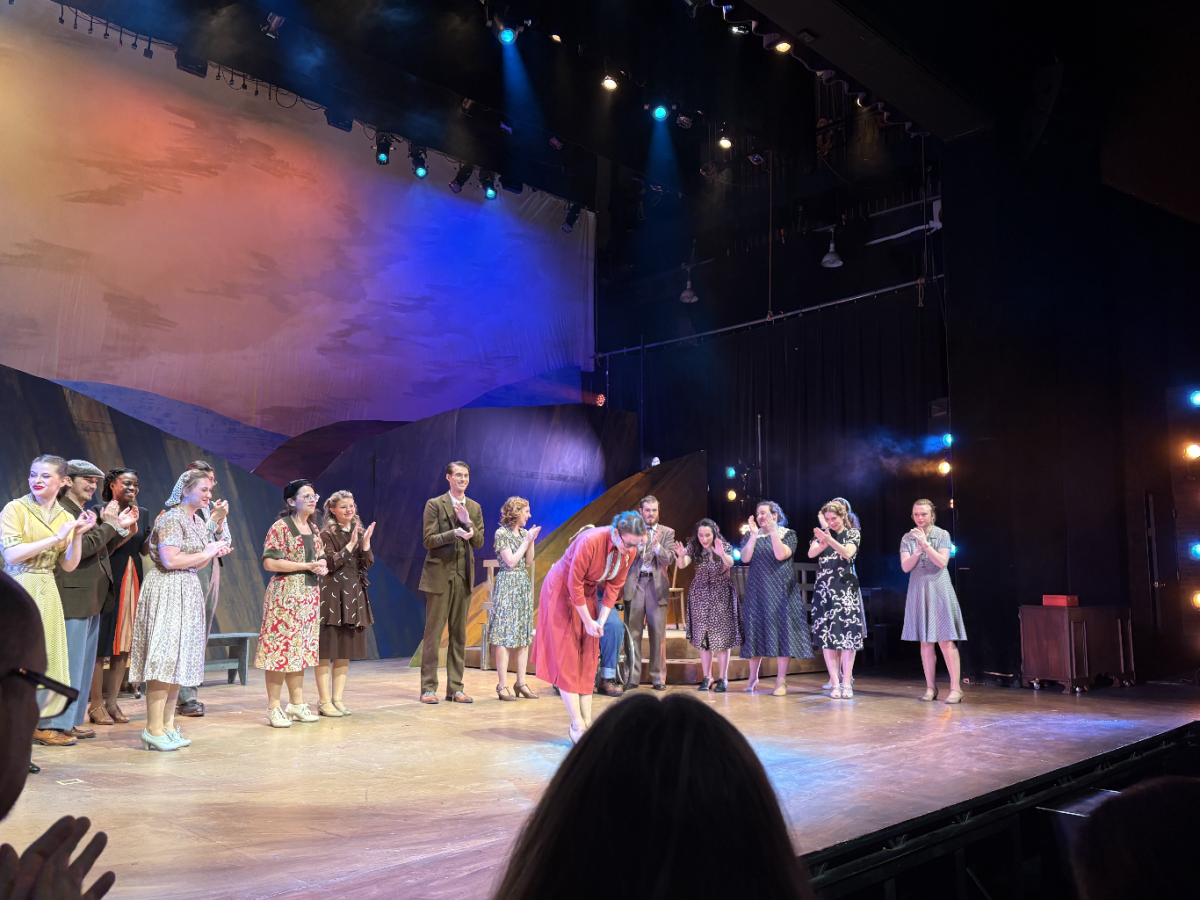


Marquette Theatre has finally returned to the Helfaer Theatre with the Pulitzer Prize-winning play, “Fairview,” opening on Nov. 14. This is the program’s first show back on campus after “Fiddler on the Roof,” which was in collaboration with Skylight Music Theatre in October.
“Fairview” is a thought-provoking comedy that follows a middle-class African American family as they prepare for a birthday dinner. As the play unfolds, the storyline unravels into a larger commentary on race, exploring its complexities and misconceptions.
Before seeing “Fairview,” I didn’t think I’d ever find myself being simultaneously entertained and intellectually challenged. But, somehow, “Fairview” incorporated these themes and accompanied them with phenomenal performances and comedy that had me immediately obsessed.
The play is set in the Frasier family home. Upon first seeing the set, it truly felt like I was invited into one of my neighbors’ homes, decorated with family portraits and dirty laundry sprawled across various pieces of furniture.
Act 1 opened with Beverly, played by Lauryn Middleton, a junior in the College of Communication, peeling carrots while dancing along to music to prepare for her mother’s birthday dinner. This particular dinner is the root of much of Beverly’s frustration throughout Act 1, as the continuous mishaps while preparing it cause her to be hostile towards her family members.
Middleton brought pure mom energy to Beverly. This scrambled and stressed persona radiated off of her, and when she shouted for her various family members, even I shot up in attention.
While dancing in the living room, Beverly is then surprised by the unexpected arrival of her husband, Dayton, played by Draylin Pickett, a junior in the College of Communication, who flirtatiously admires his wife.
Throughout the remainder of Act 1, the audience is familiarized with the confident and fashionable Jasmine, Beverly’s sister, played by Kylee Ramsey, a sophomore in the College of Education, and Keisha, Beverly’s daughter, played by Esther Akinsanya, a junior in the College of Arts & Sciences.
In particular, Jasmine’s bougie and self-obsessed lifestyle interacting with Beverly’s selfless and humble personality was hilarious to watch.
Act 1 maintained Beverly’s frantic preparations, continuously being interrupted by the tomfoolery from her family members until the end of the act, when Keisha unexpectedly speaks to the audience.
In her brief soliloquy, she expresses her excitement for her future while admiring her family members dancing together but mentions that she feels “something” is keeping her from achieving her goals.
I didn’t know it then, but this seemingly out-of-place fourth wall break would set up the core message for the remainder of the play.
As the pressures of this birthday dinner and the management of her chaotic family culminate, Beverly’s stress eventually comes to a climax, and the act ends with her fainting.
As the lights filled the theatre for intermission, I realized that Act 1 was only 30 minutes long. Surprised, I looked at the program to find out that there were still 90 minutes for the remaining two acts, leading me to ask, “What story is left to tell?”
When Act 2 began, confusion shot through me as Beverly appeared on stage exactly as she had in the first act, peeling carrots and dancing to music. For a minute, I thought a second showing had begun. My confusion only increased when I whipped my head around to see two white characters appear from the back of the theatre, loudly arguing over the controversial question of “If you could choose to be any race, what race would you be?”
The inquirer of this question, Jimbo, played by Michael Kratzer, a sophomore in the College of Communication, epitomized the racist white persona and had an interesting perspective on the question. In contrast, Suze, played by Erin Cavender, a senior in the College of Communication, debated the insane nature of the question and initially refused to answer it.
As the two argue on stage, the events of Act 1 in the Frasier house continue in the background, except that the family is not audible.
As the debate continues, two additional white characters enter to share their perspectives on the topic. Mack, played by Brandon Engel, a senior in the College of Communication, and Bets, played by Eva Hesse, a senior in the College of Arts & Sciences, bring diverse but problematic takes on the topic.
I found myself consistently belly laughing at the characters’ bizarre arguments to the question, as well as their responses to one another with their natural banter.
As these characters conversed, it was clear that each one thought they were being progressive in their narrow understanding of race.
Even for characters like Suze, who performed the role of the stereotypical liberal white woman, her opinions exuded performative wokeness, as her discussions about race were obsessive and exuded a superiority complex, as she appears to believe that she has a better understanding of the Black experience than the fellow white characters.
The other characters on the stage, as they conversed casually, observed the scene behind them, occasionally commenting on the actions of the Frasier family. While in the previous act, this family portrayed so much character, the introduction of these characters shrunk them down to puppets, into templates for these characters to push their stereotypes onto. Despite them facing away from me, even I felt like I was being watched.
Act 2 closed with a threatening monologue from Jimbo, which acted as a commentary on how white people feel as though they are both the villain, victim and the main character for other ethnic groups to center their lives around.
As Jimbo shouted at the audience, I shrank into my seat, hiding from each word that came from his mouth.
Act 3 began where Act 1 left off, with the Frasier family helping Beverly out of her fainting episode. As Beverly recuperates, she invites her mother downstairs to enjoy her birthday dinner. To the audience’s surprise, the upstairs bedroom door opens to reveal Suze, dressed in a turban, greeting the Frasier family. The rest of the Frasier family greets Suze as if she were Beverly’s mother, but Keisha senses something is wrong and can’t quite pinpoint what it is.
As the scene continues, the remainder of the white cast from Act 2 is introduced as various members of the Frasier’s family, each confidently dressed as gross stereotypes of Black people.
Despite the horrifying oversimplification of Black people portrayed by these characters, this ignorance and absurdity only further played into the humor of the scene for the audience.
Keisha’s discomfort only grows as each of these characters makes themselves comfortable in her home and hits a climax when the white characters stir the pot and cause the Frasier family to erupt into a food fight.
Eventually, after confronting Suze, Keisha falls into a long-winded monologue that begins by asking white members of the audience to come up on the stage.
As she continued to speak, various members of the audience joined the cast on stage. Initially frightened of the prospect, I remained in my seat until I gained the courage to join the fellow audience members.
As the bright stage lights hit my face, I felt eyes all over me. I found myself continuously fixing my hair and adjusting my outfit. My privacy felt invaded, which I now realize was exactly the point.
Keisha’s monologue was powerful and brought the show to a perfect close. Her sincere yet forceful tone truly illustrated this feeling of desperation and left a heavy sense of guilt within me.
I don’t usually find myself speechless leaving a theatre, but after “Fairview,” I realized that, at least for a moment, I can and should just listen.
“Fairview” will be performed at the Helfaer Theatre Nov. 20-22 at 7:30 p.m. and Nov. 23 at 2:30 p.m. Tickets can be purchased here.
This article was written by Elise Emery. She can be reached at [email protected].