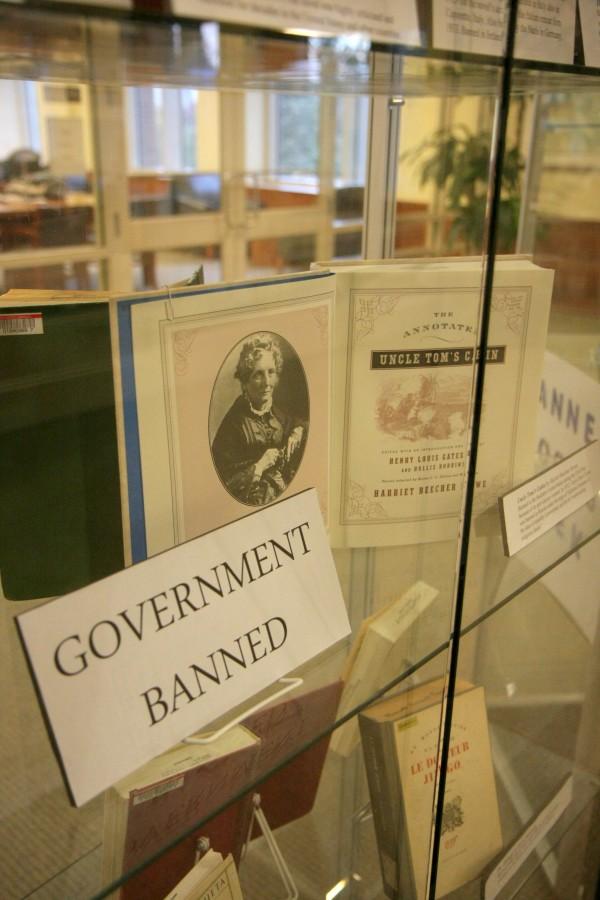

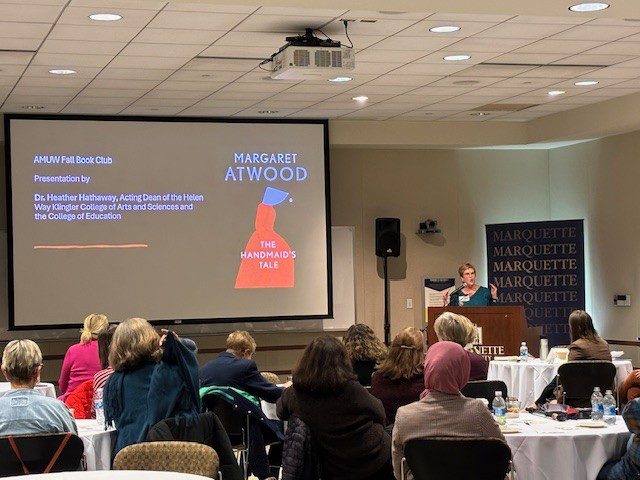
On the night of Oct. 27, the Association of Marquette University Women hosted their fall book club and discussed Margaret Atwood’s novel, “The Handmaid’s Tale.” This event comes three weeks after the nationally recognized Banned Books Week, which is promoted by the American Library Association.
Banned Books Week has been around for over 40 years, and the ALA provides free resources, downloads and resources that draw national attention to challenged books and their restriction.
AMUW was founded in 1938 to support female students at Marquette University, and the book club was established in 2007 and is still hosted biannually. Despite it being a women’s association, all are welcome.
“We wanted to create a book club that is doable,” Kathy Kavemeier, Class of ’65 and one of the book club’s founders, said. “It’s only two books a year.”
“It’s a very diverse group,” Donna Farrell, Class of ‘70, said. “I remember one night there was a table of young moms, they had left the babies at home, and this was their night out.”
Before being called on to act as dean of the College of Arts & Sciences, Heather Hathaway taught Margaret Atwood’s “The Handmaid’s Tale” in her banned books class.
“Discussion about complex issues posed in books broadens minds and understanding of one another,” Hathaway said.
The AMUW board in addition to members of the AMUW decide what books are read and chose Hathaway to lead the discussion.
Despite the book being a dystopian, fictional account of a post-civil war United States, Atwood did not include anything that had not already occurred in history or any technology that was not already available at the time. These events include “The Indian Adoption Project” of 1958 — where Native American children were stolen from their reservations, mandatory Puritan dress codes in the 1600s and the Lebensborn programme in 1930s Nazi Germany.
“I think sometimes fiction lets us understand someone’s life better in a more relatable way than a nonfiction account of it could,” Marybeth Jacobson, Class of ‘81 and president/co-chair of the AMUW Leadership Council, said.
Attendees were given about 20 minutes to discuss the book and provided reading questions, if inclined, with their small tables before discussion opened up to the large group. The discussion was structured like an English class, but unlike most Marquette courses, multiple generations of women gave their input.
Hathaway’s discussion questions focused on the historical context of the book’s central themes in addition to the real–world implications. Many of the books chosen for the book club are written by women and are centered on the female perspective.
“I was especially interested in if or how views of the book might vary by generation and gender, compared to my class,” Hathaway said.
AMUW is behind some campus programming that helps set students up for success, including multiple scholarships, the Raynor Library study rooms and what started it all, the Alumnae House.
The Alumnae House was opened in 1938 and was the university’s first women’s residence hall. This project was a result of the lack of housing options for women that surrounded campus. Following this project, the association was perhaps the largest contributor to the building of O’Donnell Hall in 1952 on land the AMUW bought on its own. The association deeded its property to Marquette University but continued to raise money for the hall.
“It’s one of those MU alumni groups that carries on across generations, which grandmothers and mothers and daughters all choosing to be involved.” Hathaway said.
The association is set to host another book club in the spring. More information about the AMUW can be found on their website, https://alumni.marquette.edu/amuw.
This story was written by Mina Marsolek-Bonnet. She can be reached at [email protected].