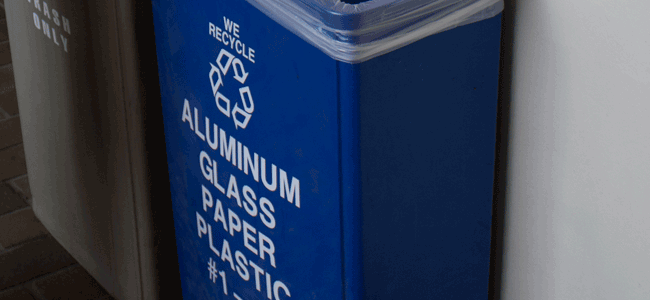

Every year, a familiar rumor circulates campus, “Marquette doesn’t actually recycle.” Students claim that the contents of recycling bins are ultimately thrown away, making their sorting efforts meaningless. This assumption oversimplifies a far more complex issue. Recycling program effectiveness often depends not only on if an institution like Marquette attempts to recycle, but on how well individuals sort their waste.
Contamination, the mixing of non-recyclable materials with recycled ones, is the leading reason items within the recycling bin are diverted to landfills. Understanding how contamination disrupts the recycling process is necessary to separate fact from fiction on recycling misinformation and how to participate properly. Recognizing that responsibility for successful recycling extends beyond the university and to the individuals that contribute.
Marquette University utilizes single-stream recycling, where all recycled items are collected in one bin and sorted at an offsite Materials Recovery Facility. The benefit of single stream recycling allows more plastics to be recycled and increased participation.
However, mixing various materials can lead to improper recycling practices and increased recycling contamination. According to the 2022 Institute of Scrap Recycling Industries analysis, contamination rates in single stream recycling facilities exceed 20% in 40% of U.S. recycling facilities. Of this contamination percentage, food waste and plastic bags are the primary culprits.
At Marquette University, the recycling system is designed for functionality and ease. However, like any system, it relies on participation and accuracy. When people fail to rinse containers, toss semi-empty coffee cups or place food-stained containers into the recycling bin, the recycling process is hindered. So, the rumors that circulate recycling on campus are not the lack of, but rather the accuracy of individuals properly recycling and contributing contaminated materials.
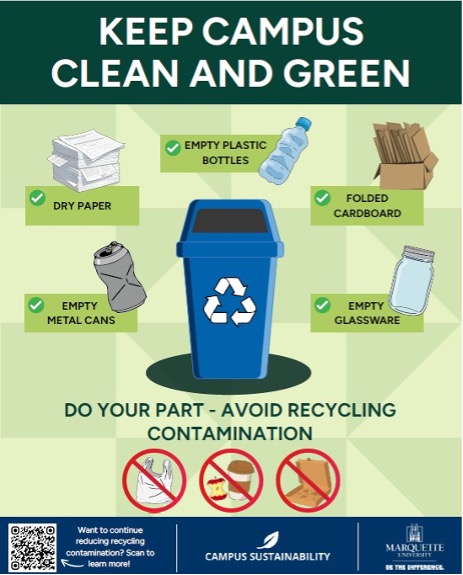
To provide transparency on what is and what is not acceptable to recycle in Marquette’s single stream system, through the help of The Arrupe Center’s Social Responsibility Microgrant, Campus Sustainability has designed and implemented informational signage for recycling bins across campus. The signage was created to draw Marquette community members’ attention to the reality of recycling before they make their decision, with the goal of informing campus about proper recycling. With this updated signage, the ‘dos’ and ‘don’ts’ are clear:
It is important to avoid contributing to recycling contamination. This makes recycling less efficient, as material is no longer reusable with these effects, and it is unsafe for people who work with the material. This worsens both environmental and public health. When collected recycling has contamination, the entire load is redirected to the landfill, meaning that even the ‘clean’ recycled materials that were properly sorted end up as garbage. Landfills, although necessary, have a huge environmental cost. According to the EPA, they are the third largest source of human-related methane emissions in the U.S. These methane emissions, along with land use, contributes to climate change.
Paying attention to how you sort recyclables from waste makes a significant impact, even when it takes little effort. Each item tossed into the correct bin lessens recycling contamination. On campus, we can debunk the speculation of Marquette not recycling. What is recycled on campus reflects our university member’s ability to properly sort materials. Putting effort into sorting can decrease the amount of waste diverged from landfills and allow Marquette to make a difference when it comes to our environment.
If you ever have a question on what can be recycled, check out Marquette Campus Sustainability’s website, or email [email protected]
This story was written by a guest opinion columnist, Christina Martino. She is an intern at Marquette Sustainability and a contributor to the Marquette Wire’s monthly NO PLANET B column.