
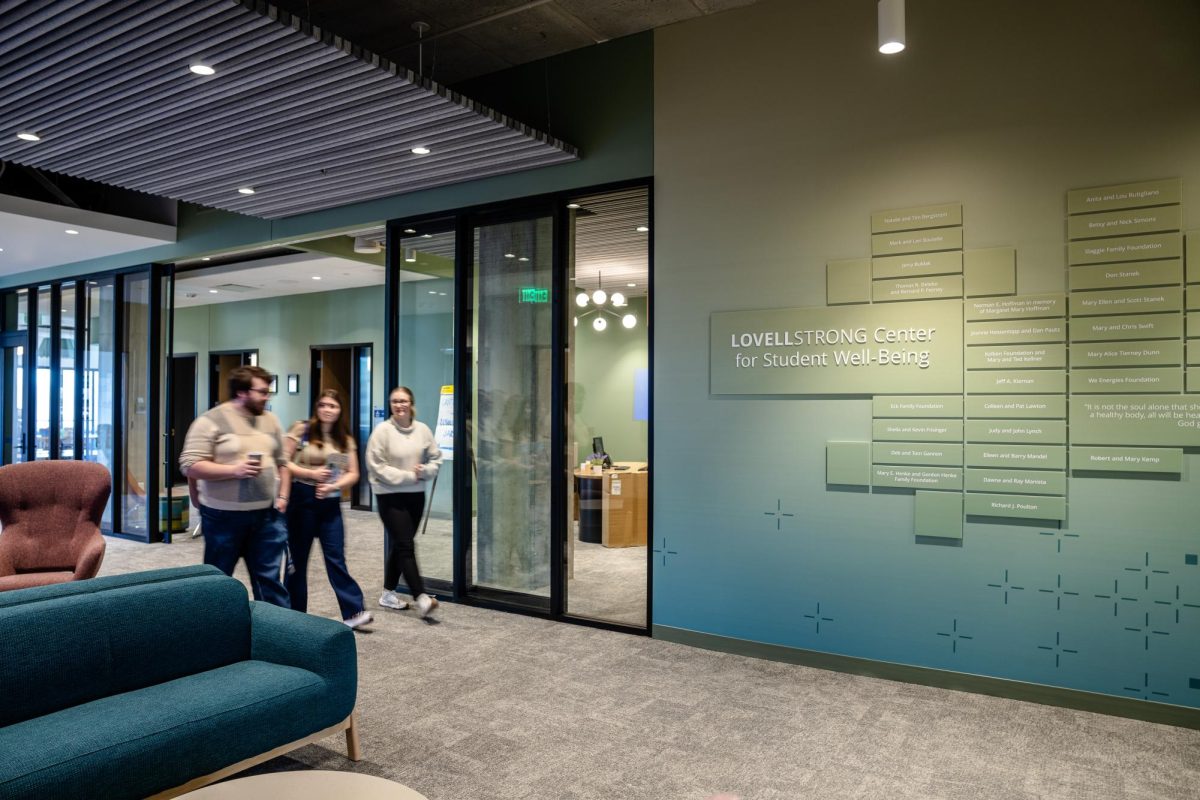
The counseling center at Marquette University operates on individualized care. This means the resources for students, number of sessions and frequency of care are determined on a case-by-case basis. Some students say this model works for them, others expect more.
“The one thing people need to be mindful of is your expectation can’t be too high with counseling,” Eli Hincapie, a junior in the College of Communication, said, having heard mixed opinions from students.
The center’s service model is “time-limited,” which Brenda Lenz, licensed professional counselor and director of Marquette’s Counseling Center, said can be hard to define across every student, but can be understood as a temporary period of counseling sessions. Some students can have their needs met in three or four sessions, while some spend weeks working with counselors.
“If we can accommodate [a student], we will,” Lenz said. “If we are unable to accommodate [them], then we’ll have a conversation about figuring out the best way to get that need met.”
Marquette’s center is unique, as its services are only available while students are in school.
Lenz pointed out that a lot of students seek counseling for stress management and short-term situations, which can be resolved with a low number of sessions. She emphasized, though, that students can always return to the center even after their previous needs were met or if a new problem arises that the center can assist with.
First appointments at the center are dedicated to an assessment of needs and exploring what students can accomplish with a counselor. Lenz said counselors are trained to recognize if a student needs something more than what the center can provide. When students are referred to outside therapy, it’s often for cases of more severe or ongoing mental health concerns, or if committing to routine, long-term therapy would better serve a student, Lenz said.
“We prioritize the finite amount of resources that we have,” Lenz said.
The team of clinicians — who are all licensed counselors, psychologists, social workers and certified substance use professionals — continue treating students until an appropriate outside referral is made. They provide coping tools and mental health resources until a student is linked to services that match their needs and insurance benefits.
Eliza Weiss, a junior in the College of Communication, said she appreciated her counselor’s early clarification that her services would be limited to one semester. She said transparency allows students to be cognizant when nearing the end of their sessions so there is ample time to find outside resources.
That said, students who feel they would benefit from the Counseling Center don’t usually face any obstacles deterring them from finding or continuing services.
Appointments can always be made online, over the phone, or by walking into the Center, located on the 4th floor of the Wellness + Helfaer Recreation Center. There are never waitlists for accessing care, something Lenz said the Center has always prioritized, and students can book anywhere from a few days to two weeks in advance.
“We want to be available when students need us,” Lenz said. “We want to be busy. We are built to manage busy.”
The Center operates from 8 a.m. to 4:30 p.m. on weekdays but also provides an emergency hotline available 24/7 year-round.
“Free counseling seemed like a convenient opportunity and amenity that Marquette offers,” Hincapie said.
While students don’t have to pay anything when they visit, $210 for a health services fee is included in Marquette’s cost of attendance. Most private Jesuit universities and colleges offer free counseling services to students, serving as part of the Jesuit principle of “cura personalis” (care for the whole person). Support is provided for stress, anxiety and mental health by professional clinicians.
In his first year at Marquette, Hincapie gave the center a shot after always wanting to try counseling, saying he made sure his expectations weren’t unrealistic.
“It’s not therapy,” he said. “Maybe some people expect more.”
Hincapie urges students not to blur the lines between counseling — a space to simply freely talk and receive comments — and therapy, which can offer “breakthroughs,” exercises, programs and psychological evaluations.
Hincapie transitioned from using the Counseling Center to attending therapy at Marquette’s Center for Psychological Services earlier this school year.
If students want something more in-depth than counseling, Hincapie recommends looking into this therapy resource at Marquette. Each visit costs $25, which he said is cheaper than outside services while also having a significantly shorter waitlist.
The Counseling Center team admits they can’t meet every need. They do, however, understand the value of a well-rounded approach to emotional well-being and psychological health.
The Center has partners on and off campus that can provide additional resources, acknowledging that counseling is only a small part of strengthening mental health. A full list of support services is available online, which includes Campus Ministry, Victim Advocacy Services, Active Minds and Aurora Health Care Healing & Advocacy Services.
Outreach to student organizations is also a way the center remains connected and receives feedback.
“If we’re not in our community, there can be lots of assumptions about who we are and what we do,” Lenz said. “We want to be approachable.”
Lenz encourages students to seek what the center offers and to understand on-campus counseling can be a resource for “time-limited” situations that arise throughout students’ college journey.
This story was written by Elena Metinidis. She can be reached at [email protected].