

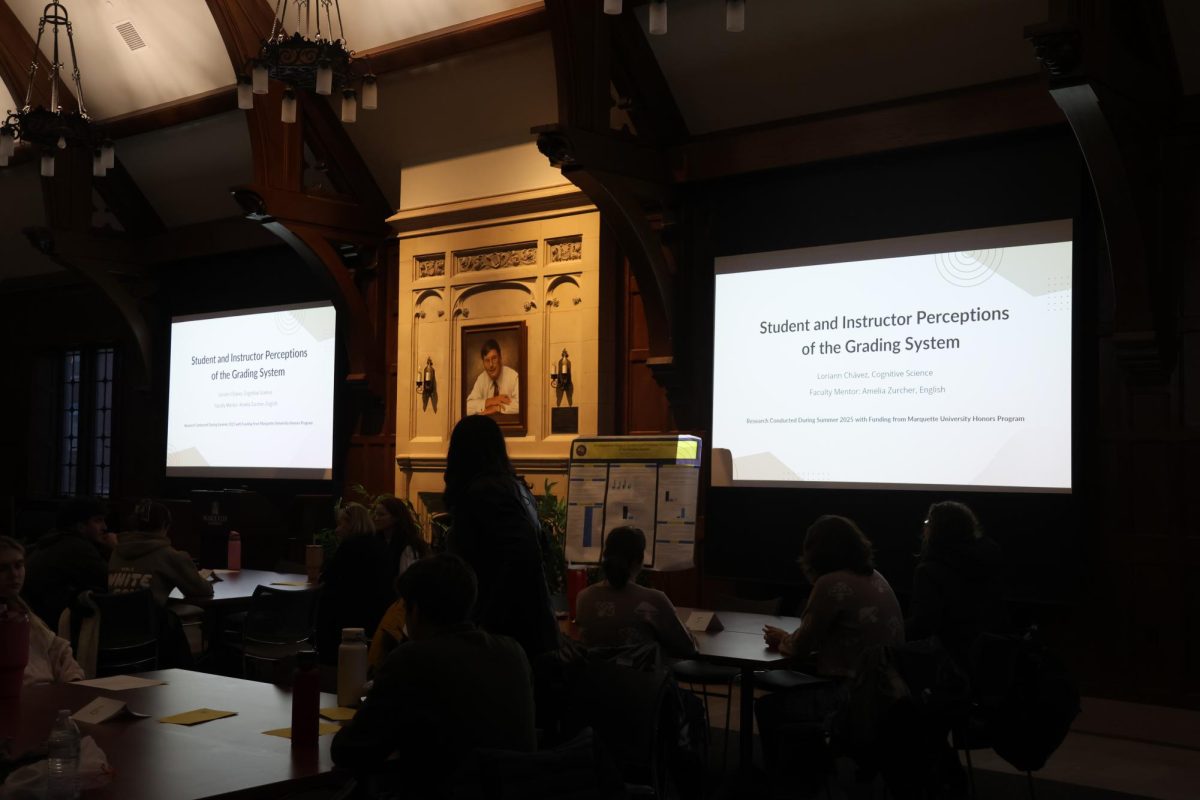
Marquette University’s Civic Dialogues and Honors Programs hosted a dinner Feb. 24 in Sensenbrenner Hall focused on the grading system in higher education.
The discussion was based on research done by Loriann Chávez, a junior in the College of Arts & Sciences. Her study uncovered perceptions of the grading system on Marquette’s campus and how it contributes to relationships between students and faculty.
The guided conversation began with reflection on the presented study and later moved into the discussion of broader concepts like the use of AI in classes, academic motivation and alternatives to the current grading system.
Chávez surveyed 218 students and 63 faculty members. When asked, “What do grades measure?” 68% of respondents agreed their grades should accurately measure their learning of course content. But, only 16% thought grades actually measure their learning of course content.
“Grades measure my ability to meet the professors’ expectations, but the grades do not always convey my level of understanding,” an anonymous student survey participant said in Chávez’s slide presentation that accompanied her research.
Another anonymous student participant said in STEM courses, grades are dependent on a student’s ability to regurgitate material. However, in humanities courses, grades are more reflective of a student’s perceived ability to understand the course material and critically think about it.
The survey also found that 65% of respondents said they disagree or somewhat disagree that Marquette’s grading system encourages creativity. 81% said they agree or somewhat agree that the grading system discourages academic and intellectual risks.
The study also measured the effect of grades on mental health, finding that 73% of respondents agreed grades have harmed or somewhat harmed their mental health. When connected to gender, the study found 79% of women state their grades have decreased or somewhat decreased their mental health, compared to 58% of men.
Gitte Frandsen, an English professor at Marquette, mentioned it’s hard to change the grading system as an individual instructor, as it’s an industry standard.
“To participate in a system that you know is doing harm to students,” Frandsen said regarding grades and mental health. “That gives me a really icky feeling.”
32% of respondents stated that an A or A- were the lowest grades that constituted a “good” grade.
“I would have to say grades put a lot of pressure to succeed, especially when others inquire about them because I’m known as a 4.0 student, so I worry about losing that,” one anonymous student respondent said.
Both faculty and students said having all of their efforts narrowed down to one letter grade is where much of the issue with the grading system lies.
“It’s very stressful because you have to give one grade … and you have to encapsulate in that number all that student has done throughout the semester,” Pilar Bellver, a Spanish professor, said. “How do you represent the whole student in one grade?”
Amelia Zurcher, professor and director of the honors program, said grades become a currency to students, limiting their value to something students exchange for scholarships or applications, making the end goal about the grade rather than the learning.
The study found 83% of respondents agreed that Marquette’s grading system, as it currently exists, encourages people to cheat using AI.
“Cheating with AI has just become a major headache for all teachers. You have to constantly think about how you design your assignments,” Frandsen said.
In addition to the study, civic dialogue dinner attendees were asked to discuss alternatives to the current grading system.
Isabella Dover, a first-year student in the College of Health Sciences, recalled doing correction questions on tests in high school, which offer students the ability to earn back credit.
“It helped me feel better about the grade because I was working towards that better grade as well,” Dover said.
Both Bellver and Frandsen agreed that giving feedback on assignments is a much more valuable way to support learning than solely assigning a grade in accordance with the current grading system.
This story was written by Mina Marsolek-Bonnet. She can be reached at [email protected].