

Grant Gosizk can now pay off some of his student loans. Chris Gooding can stop looking for a higher paying job.
Both are non-tenure track faculty members at Marquette University in the College of Arts & Sciences, and in their most recent contracts, they received a $10,000 raise.
When Gosizk got an email from the university about his raise over the summer, he had a feeling other faculty had received one too. After knocking on office doors and sending out emails, Gosizk and Gooding came to the conclusion that nearly 90% of non-tenure track faculty in the College of Arts & Sciences received a raise of around $10,000 depending on their original salary.
When Gosizk was discussing the raises with other faculty members, he noticed an overwhelming feeling of relief.
“The fact that people were struggling so much that $10,000 is making a significant difference in the lives of faculty at Marquette, I think we should be pretty embarrassed about that as an institution,” he said.
Non-tenure track faculty like Gosizk and Gooding don’t have the same job security as their tenured counterparts. They aren’t promised a job for the coming school years — rather, they sign short term contracts.
Gosizk had already signed his next 10-month contract when he got the email from administration. Now, aside from paying off some of his student debt, he can also provide financial stability for himself and his partner.
“This provides a level of security for us that, frankly, I’ve never had since I came to Marquette,” he said.
But being an English professor is more than just a job for Gosizk. He won’t consider leaving his job for a higher-paying gig, though he sometimes wishes his compensation matched the hard work he puts in every day.
Unlike Gosizk, Gooding, a professor in the theology department, said he was looking at switching career paths before receiving his raise.
“You can be a pastor in a small parish and earn more than teaching here. I could go into grassroots organizing,” he said. “The starting salary was $15,000 above what I’m making at Marquette.”
When Gosizk got the university’s email about a raise, he didn’t just read it and delete it; he wanted to know more. Why the sudden change from the administration, and why now? He suspects the answer lies with the non-tenure track faculty’s ongoing efforts to be recognized as a union, with a priority of fair compensation.
Gosizk said he thinks pressure and news coverage of the unionization efforts forced Marquette to make a change. However, the university has not associated the project with the unionization efforts.
From talking with other faculty Gosizk found the lowest non-tenure track faculty salary was raised from $43,000 to $50,000. University administration doesn’t release information on salaries, so the Marquette Wire was unable to confirm this information.
However, Kevin Conway, university spokesperson, said the raises were given to faculty that were “critically below the average salaries of faculty at comparable institutions in the Midwest in the same discipline and rank.”
The Wire requested the list of comparable institutions, and this request was denied. The university was also unable to release the total number of faculty who received raises and to which college they belonged.
Acting Provost Sarah Feldner told the Wire in an interview that the salary adjustments are loosely associated with the university’s strategic plan, and that she was involved in the process to align salaries with other institutions.
“Last year we realized that we had some work to do to reach benchmarks and get in range, particularly with our participating faculty,” she said.
She also said this is the first year of a multi-year reevaluation of compensation but was not able to share the full scope and timeline of the project.
Gosizk said the university explained in an email that the raises were a “market adjustment” to match other college’s non-tenure track faculty salaries. He and other faculty don’t agree.
“I don’t think there’s any confusion from faculty about, ‘Wow, the administration’s just opened up their hearts and their wallets out of the goodness of their own hearts,’” Gosizk said.
Over the past three years, Gosizk and other faculty have been protesting, holding picketing events, collecting data and communicating with the administration to gain recognition. This isn’t the first time non-tenure track faculty have tried to unionize; rather, it is the most recent iteration.
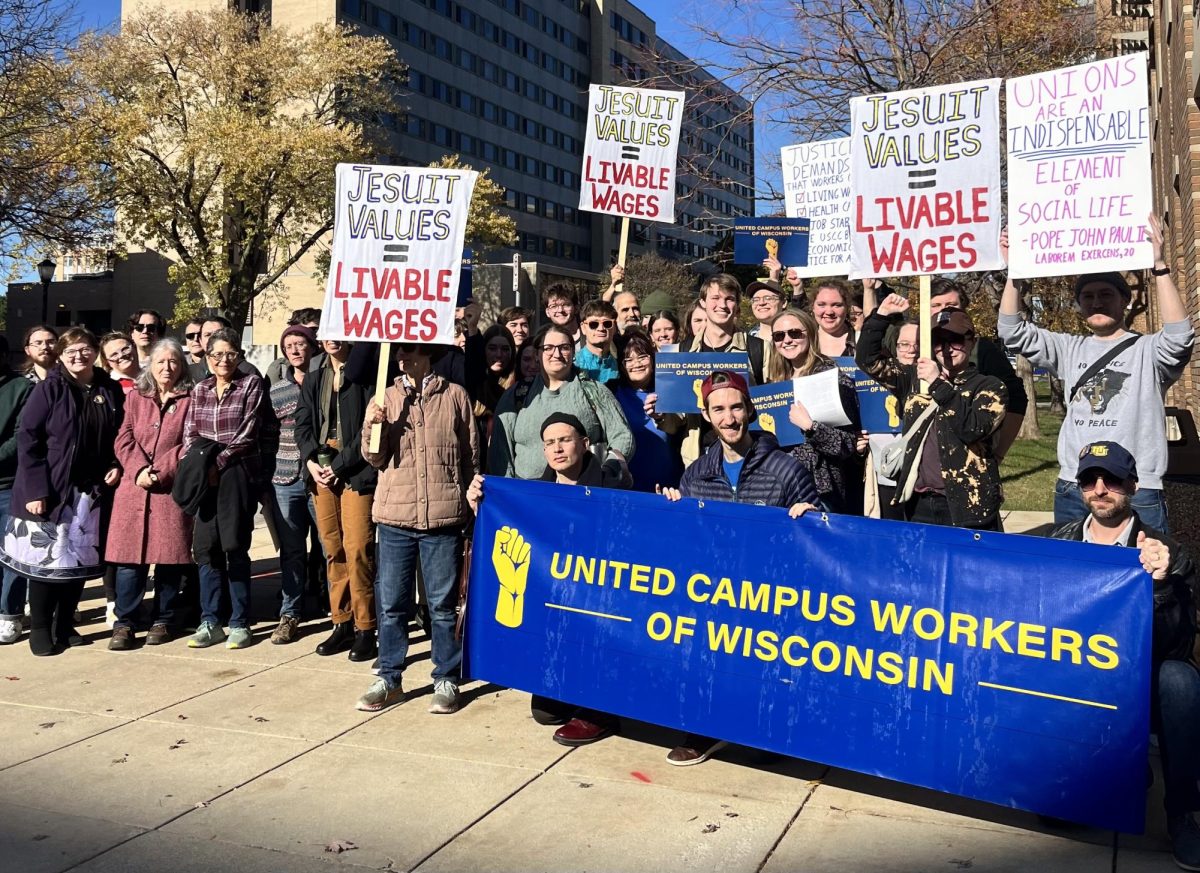
Last spring, at President Kimo Ah Yun’s inauguration, students and faculty protested outside of the Al McGuire Center, where the event was taking place. They held signs saying, “Unions are an indispensable element of social life” and “Underpaying workers is theft.”
A month after the protest, faculty from the college received what Gosizk called a “spontaneous and unceremonious” email from the administration saying they would be receiving raises.
And what Gosizk doesn’t see as an accident, the $10,000 figure was the lowest point the bargaining group requested for a raise, based on compensation data from colleges similar to Marquette.
“It seems coincidental in timing and coincidental in terms of how our raises came about,” Gosizk said.
In 2024, when the non-tenure track faculty union was seeking National Labor Relation Board recognition, Gosizk and other members met with administration.
The group sat down with university leadership and general counsel Ralph Weber to lay out their concerns. With 70% of Arts & Sciences non-tenure track faculty signing union cards, they had a supermajority status and considerable leverage for a union fight.
The university declined to recognize the union, citing a religious exemption shortly after the meeting and explaining they wouldn’t bargain with the group.
“Marquette continues to believe that our community, and especially our students, are best served by working collaboratively with all our faculty — who have a distinct role in delivering our Catholic, Jesuit mission — without needing to engage the union as an outside third party,” the university said in its statement signed by Ah Yun and Weber in 2024.
This statement came at a time when the NLRB had rolled back regulations on religious institutions, meaning even if the NLRB conducted an election for the union in Marquette’s College of Arts & Sciences, the university wouldn’t be bound by law to recognize it.
Gooding said in issuing a religious exemption, Marquette was “invoking a right to religious hypocrisy.”
“They’re saying the law isn’t compelling them to do the right thing,” Gooding said.
So, when the raises came about, Gosizk and Gooding were both caught off guard.
“This is a direct demonstration of how, when we work together, regardless of whether or not we have federal protections or federal oversight, we can create a safer and fairer workplace,” Gosizk said.
Now, the group is looking to support undergraduate and graduate student workers.
Throughout last academic year, Luke Syverud, a senior in the College of Arts & Sciences, and other students were able to garner over 1,000 signatures on a student petition explaining their support for a non-tenure track faculty union. The group hoped to sit down with administration to explain concerns they had about the faculty who teach their courses.
After delivering the petition to the administration last year, Syverud got an email saying it was received, but didn’t get any further communication.
Looking at what the faculty union efforts were able to achieve, he thinks there’s an opportunity for students to attract the same attention.
“We have conditions on campus that we would be able to improve and win for students,” he said. “Now, we feel that having the ability to work alongside them [non-tenure track faculty members] on campus gives us more support for this campaign.”
So, even though the first demand on the bargaining group’s list of requests was fulfilled quietly by the administration, the faculty group isn’t done yet.
“Because things are quieter doesn’t mean that there’s no activity,” Gooding said. “Usually when people notice that unions are pretty active, it’s because we’re doing the loud stuff like protesting.”
If you’re a non-tenure track faculty member interested in talking to the Wire about your raise, reach out to the managing editor of the Marquette Tribune at [email protected].
This story was written by Sophia Tiedge. She can be reached at [email protected].