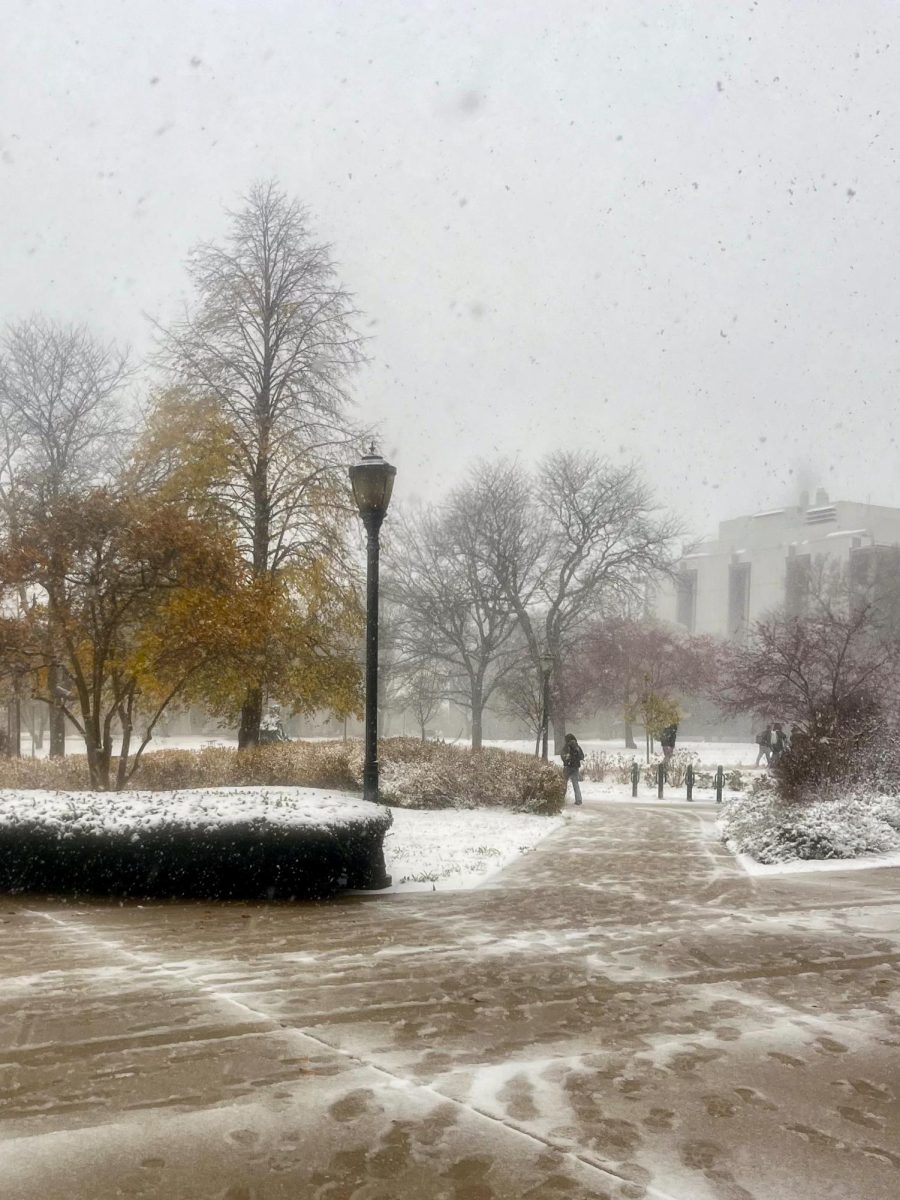


When Marquette University students returned from Thanksgiving break, Milwaukee looked a bit different. What were once clear sidewalks and roads became patches of snow and ice — a window into the Wisconsin winter on the horizon.
Those winters are synonymous with the Badger State, where temperatures drop and snowplows trudge through streets from December to February. Though each year brings a different mix of winter weather, the cold, dark days all assimilate students to life in Milwaukee.
“How can you not like snow?” Mark Baden, chief meteorologist at WISN Channel 12, said. “It snows here. If you’re going to school here, this is part of what we do.”
Baden spoke with the Marquette Wire to preview what students can expect for the coming winter.
For the second consecutive year, a La Niña winter pattern is hitting the United States, which in several southern states creates a warmer season. But in Wisconsin, it leads to slightly below average temperatures and increased snowfall.
La Niña winters result from cooler surface temperatures in the central equatorial Pacific Ocean. Those cooled waters alter the positions of jet streams, shifting wind patterns as the calendar flips to winter. Typically, La Niñas arise every 3-5 years.
“It’s rare to keep a strong La Niña two years in a row,” Baden said.
While the coming La Niña is expected to be on the weaker side, it is still projected to cause above average precipitation. Of the 12 weak La Niñas recorded by the National Atmospheric and Oceanic Administration since 1954, nine of them brought added snow to Wisconsin.
The National Weather Service’s Nov. 20 model listed most of Wisconsin as 30-40% likely to have above average precipitation from January 2026 to March 2026. Temperature-wise, the model gave Milwaukee an equal chance of facing above average, below average or normal conditions.
While those conditions are set for early 2026, Milwaukee got a taste of winter with the season’s first snowfall over Thanksgiving weekend. That snow, Baden said, will stick around for a little while, as it spans the Midwest from Missouri to Indiana. However, the blanket of snow — known as a snowpack — is likely to melt before another heavy snowstorm rolls through.
“It’s very rare for Milwaukee, in this area, to start in December with snow on the ground and make it all the way through with a snowpack,” Baden said.
According to WISN 12 data, Milwaukee’s longest stretch with at least an inch of snow on the ground is 112 days, which spanned the entire winter in 1979. In 2021, snow covered the ground for 68 days, but more recent years have failed to yield a consistent blanket of snow.
That probability makes the late November snowfall a trial run — an opportunity for students to get acquainted with a Wisconsin winter before coming back to school in January.
“You definitely have to readjust and remind yourself it isn’t an easy winter,” Moses Vived, a sophomore in the College of Business Administration from Fresno, California, said.
While Vived prepares for his second winter on Marquette’s campus, several first-year students will face a Wisconsin winter for the first time, including fellow Californian Alex Delucchi.
“I had one warm jacket and another thing to keep me warm, but I’m probably going to have to get a little more prepped for what’s to come, especially with the wind that I’ve heard about from upperclassmen,” Delucchi, a first-year in the College of Health Sciences, said.
Both Vived and Delucchi are looking to enjoy the snow but are wary of the cold days around the corner in January and February. While temperatures in his hometown rarely get below freezing, Delucchi is balancing intrigue with the potential for the snow to quickly get old.
Growing tired of the snow and cold can be natural, Baden said, but the best way to adjust is to make an effort to enjoy winter. Some Marquette students welcomed the season’s first snowfall by building snowmen and having snowball fights. Those moments, Baden said, are opportunities to get acclimated to the cold months in Wisconsin.
“If you don’t embrace it, you’re never going to enjoy it,” Baden said. “If you’ve never gone skiing, go skiing. Do fun stuff in the winter. Go ice skating outside. Yeah, it’s cold — but you get through it.”
This story was written by Lance Schulteis. He can be reached at [email protected].