

Every Monday, Wednesday and Friday afternoon in Johnston Hall, around 50 Marquette University students travel 20,000 years into the future.
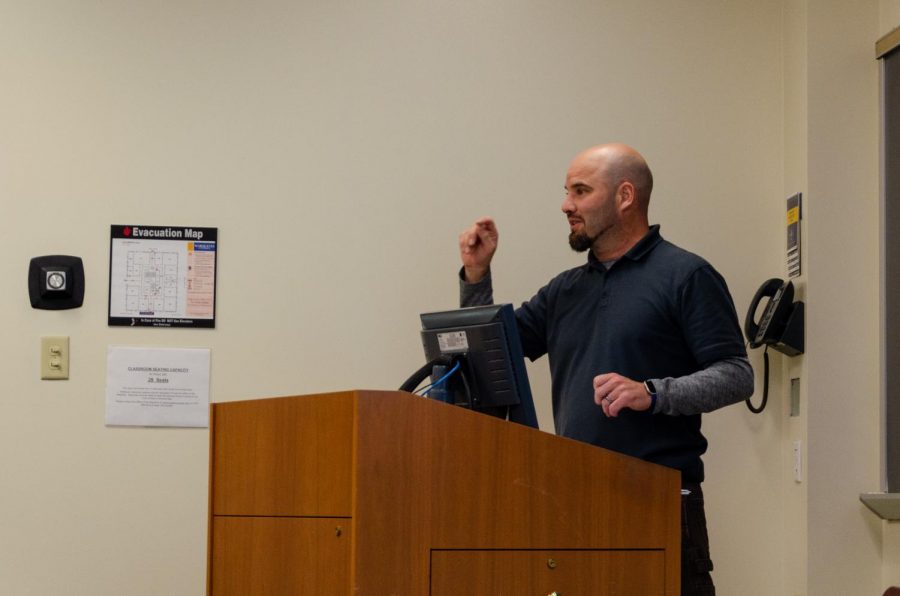
Gerry Canavan, an English professor and department chair, is the one doing the transporting. Through his science fiction-themed class, ENGL 4716, Canavan and his students analyze current societal themes through the lens of Frank Herbert’s “Dune” book series, set in a futuristic environment where humans have colonized the entire galaxy and no longer maintain democracy or equality.
“When you give [students] an object like ‘Dune,’ it’s different than giving them ‘Hamlet’ because they know what they’re supposed to say about ‘Hamlet,’” Canavan said. “You don’t know what you’re supposed to say about ‘Dune,’ so it opens the door to different kinds of conversations.”
The class was created for the book’s 60th anniversary and because of how popular “Dune” is thanks to the recent movie adaptions, Canavan said. Most literature courses at Marquette allow for about 20-30 students, he explained, but this class was opened to over 50 students this semester, with a few even left on the waitlist.
Canavan also teaches an English course about the works of J.R.R. Tolkien, author of “The Hobbit” and “The Lord of the Rings.” However, he said, the “Dune” class has superseded the popularity of his Tolkien class.
“In part, that’s just the interest in ‘Dune,’ and this sense that ‘Dune’ speaks to our moment – despite being so old – in a really interesting way,” Canavan said.
The class, while appealing to English majors, also includes students from majors like engineering who have never opened the book.
But one student, a fifth-year physics and mechanical engineering major, has read the entirety of the first “Dune” novel and is knowledgeable about the rest of the series.
Leo Ruffolo wanted to be part of Canavan’s “Dune” class so badly that he sidelined a course for his physics degree this semester. He first became interested in the science fiction series while working on an AP English Literature and Composition project in high school.
“What would I want more than to take a class about a book that I love?” Ruffolo said.
Students like Ruffolo divide into breakout groups to discuss different themes and moments in the “Dune” books, including politics and religion, the cerebral effect of drugs, gender issues and the environment. Canavan and his students explore how relevant — and often prophetic — the series is considered to be, despite being first written in 1965.
Canavan said Herbert, the author, foresaw how society was going to evolve around issues like global colonization and hallucinogenic drugs that are increasingly relevant today.
“There’s something of value to just sit in a class with all these people and a really smart professor and actually talk about these things,” Ryan Smith, a sophomore in the College of Communication, said. “We’ve had crazy conversations in that class.”
Smith, who had already read “Dune” and wanted a chance to analyze it in greater depth, enjoys discussing topics like quantum theory and drug addiction through a science fiction lens. Both he and Ruffolo are in the breakout group that focuses on religion and politics, where they read literary theory and analyze how the books relate to current policy or how it draws on history.
One parallel Smith sees between “Dune” and modern reality is addiction to harmful resources. In the books, civilization harvests a hallucinogenic drug called “the spice” from oil reserves to make interstellar commerce possible.
“In the story, people are addicted to spice, and in the real world we’re sort of addicted to drilling oil even though we know it’s going to kill us, kill our planet and run out eventually,” Smith said.
Discussing “Dune” themes like addiction in a group setting is much different than having to analyze the books alone, Ruffolo said. He added that there are many lessons in Herbert’s writing that are timeless and can be applied now more than ever.
Throughout the semester, Canavan’s students will read the entirety of the first and second “Dune” books, as well as excerpts from the third and fourth books. The class will likely be offered every other year, though Canavan said he wants to make sure to do more before the “Dune: Part Three” movie comes out in late 2026.
For now, students are focused on their open-ended final projects, which can be anything from an illustrated comic to a screenplay about “Dune.”
Canavan, who has seen how much his students have engaged in the class so far, is also enjoying the class on a personal level. He said teaching such a course has helped him understand the “Dune” books in a way he hasn’t before.
“It’s just a very strange text that seems to be taking you in one direction and then pulls the rug out from under you,” Canavan said. “It’s fascinating.”
This story was written by Mia Thurow. She can be reached at [email protected].