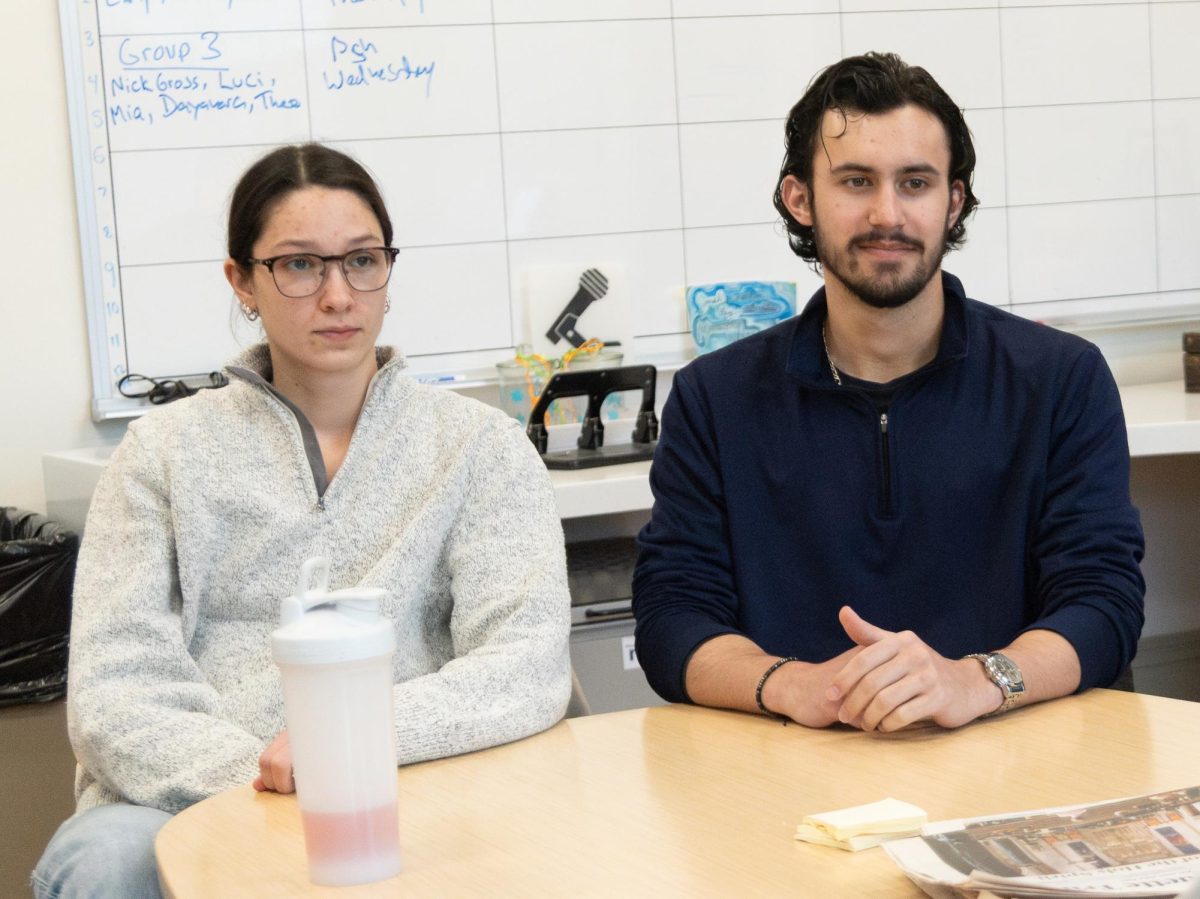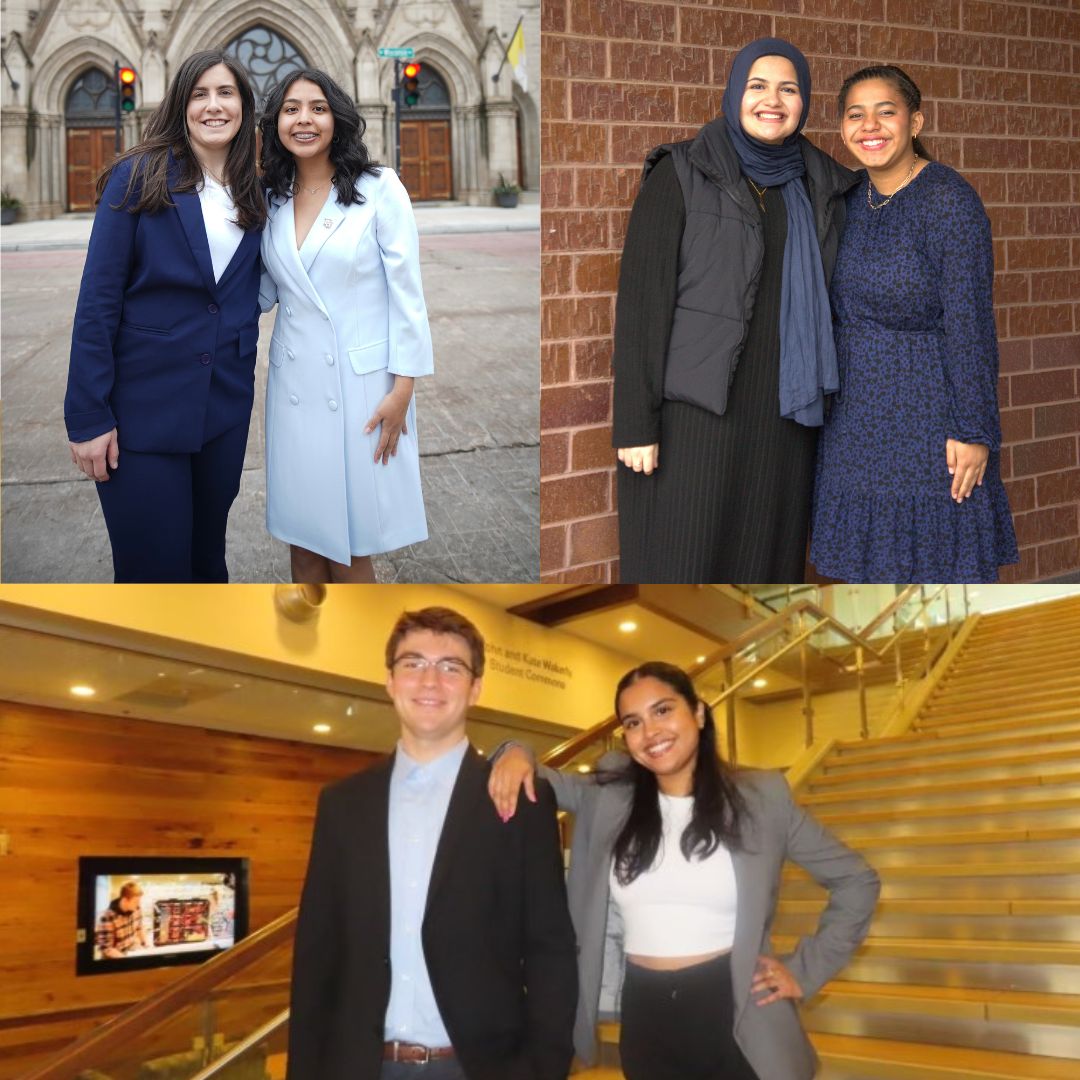


Settled into their Alumni Memorial Union offices for the year, Marquette University Student Government President Julianne Browne and Executive Vice President Adam Brzezinski are ready to hit the ground running.
Browne, a sixth-year senior in the College of Arts & Sciences, and Brzezinski, a senior in the College of Communication, outline their goal for Marquette in three words: “High School Musical.” In search of connection on campus, their dream is to see Marquette’s relationships model that of the Disney movie’s East High.
In wanting large groups of friends at a basketball school, the film became an easy mock-up for Browne and Brzezinski to describe their narrative and mission over the summer.
“We don’t just want the high energy and the pride at Fiserv Forum. We want it to be seen in the green spaces and our buildings. We want to be able to [walk] down the street and say hello to a stranger,” Browne said. “We’ve been brainstorming and thinking of ways to bring us back to interacting together face-to-face, getting that human connection back on campus.”
So, what does that connection look like?
MUSG staff began the year helping students move in, carrying belongings to dorm rooms and meeting the new wave of Golden Eagles. Browne and Brzezinski hope that future move in days will involve as many upper-level students as possible, including those outside of MUSG, to create a school-wide tradition.
“We got to learn about them [and] they got to learn about us and what we do,” Brzezinski said. “I remember as an incoming freshman or even a sophomore, you have your little cliques, but it’s very rare that you really connect with the upperclassmen.”
MUSG also set up lawn games across Eckstein Common near the AMU and bonded with students over games of bags and spikeball.
There are still a few other items on their to-do list, including the six pillars they proposed during their campaign last spring.
Student Organization Funding
Student Organization Funding is designed to fund university clubs and activities, but according to Brzezinski, the process is not as known among some campus organizations. SOF is accrued through tuition each year, which includes a student organization fee.
MUSG will host training sessions in early September for student organizations to walk through the process of using SOF, from requests to reimbursement.
“A big thing that we’ve been striving for is to make the clubs more aware of what they’re capable of,” Brzezinski said. “We have this money. We want to give it back to the clubs and the students because it’s coming from them in the first place.”
MUSG hopes that trainings and educational measures for SOF will enable clubs to put on bigger events to serve the student body.
AEDs across campus
AED installation is part of a personal project for Browne. Last semester, she started the Emergency Preparedness Club, which promotes training for health emergencies, public outreach and fundraising.
In cases of cardiac arrest, survival chances drop from 7-10% for each minute a normal heartbeat isn’t restored. In Browne’s vision, colleges would increase AED accessibility by purchasing them for academic buildings while the club will cover maintenance costs, such as the replacement of expired batteries and pads.
While the university has not signed off that relationship yet, Browne will look to resume the discussions in the weeks to come.
Reworking course textbooks
To remove the added expense of textbooks for students, Browne and Brzezinski hope to introduce more open resources to Marquette’s library database. The university would subscribe to online textbook platforms and the cost would be included in student tuition.
The library has put in a grant application to buy open resources, though approval of a new collection of materials would require adjustments to course curriculums throughout the university. Because usable textbooks would be limited to the online platform, some professors would have to adjust their required materials.
Reinstating the Good Tenant Program
Browne and Brzezinski also hope to revive the Good Tenant Program, which assisted juniors and seniors applying for campus-owned apartments. The university would advocate for students as good renters, vouching for their ability to pay rent on time and respect the property.
Marquette also has a grievance resolution process to manage off-campus relationships between landlords and tenants.
Browne and Brzezinski have met with Mary Janz, Director of the Office of Residence Life, to discuss a new version of the program, which would extend to off-campus apartments. The perfect arrangement, according to Browne, would also allow landlords to be held accountable for maintenance and rent management, though talks to reinstate the program are still in the preliminary stage with General Counsel.
Accessible groceries
With the exception of Sendik’s, Marquette is in a food desert with limited access to groceries. Initially, there was a proposal to expand Eagle Express vans to take students to grocery stores, though the idea was shut down by the Marquette University Police Department because it would require a larger service range.
An alternative option would be the creation of an app to help students carpool for grocery trips, though it currently sits in the idea stage.
Reimagined prayer spaces
Following a student push to reimagine prayer spaces for the Muslim community, Browne and Brzezinski are looking to put those plans into action. Brzezinski said the priority is creating places that are safe and fit for practice, with the added possibility of a space that can meet the needs of all faiths.
While that project has been internal among students, MUSG will take those discussions to school administrators to determine the best course of action.
A ripple effect of change
Browne and Brzezinski will be the first to admit that they may not reach all of their goals during their time in the MUSG office. They’ll also be the first to admit that none of them may be fully finalized within those seven months.
Instead, the two want to build a Marquette community with shared goals. Wanting to be the first dominos in the ripple of change, they hope that future students will continue their efforts long after they leave.
“We want the flame to be ever-burning,” Browne said, “If we can get a little snowball going and push it down a hill where it’s getting momentum, that’s our goal.”
This story was written by Lance Schulteis. He can be reached at [email protected].