
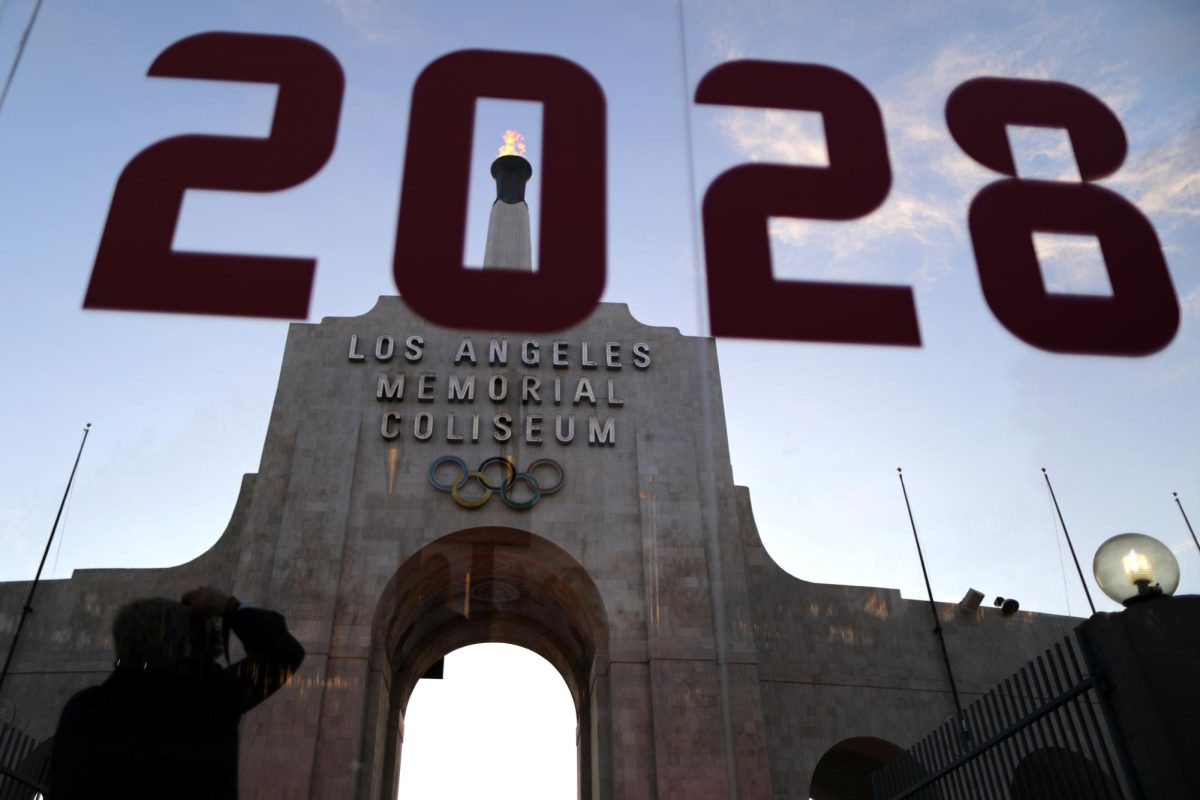
Following the 2026 men’s FIFA World Cup and the 2027 Super Bowl, the 2028 Summer Olympics will be held across over 80 venues in Los Angeles, with an expected attendance of over 10,000 athletes and millions of spectators. As people’s attention turns to this upcoming historical event, the detrimental impacts on LA’s people and environment must be considered.
Olympic host cities are chosen through an extensive process involving National and International Olympic Committees holding continuous dialogue for typically two years. Cities begin by applying to be a host city, then an Evaluation Commission rigorously evaluates the applicant cities and the final choice is elected by the International Olympic Committee. As a former host city in 1932 and 1984, LA was chosen to host the 2028 games because of its advanced infrastructure and history of being a host city for major sporting events.
On the surface, hosting the Olympics seems like a sensible idea for LA. As the second largest city in the U.S., it has everything an internationally renowned city could offer — it is a cultural hub and notorious for its film and technology industries. LA will benefit from the games’ grand profit, currently predicted to be between $13 and $17 billion. However, by hosting the Olympics, LA’s environment and people risk experiencing dire consequences.
The American Lung Association ranks LA as the smoggiest city in the U.S. Smog is formed by ozone and particulate matter from vehicle emissions, as well as synthetic emissions from volatile organic compounds. This combination forms the ground-level haze that LA is susceptible to due to its positioning in a valley surrounded by mountains.
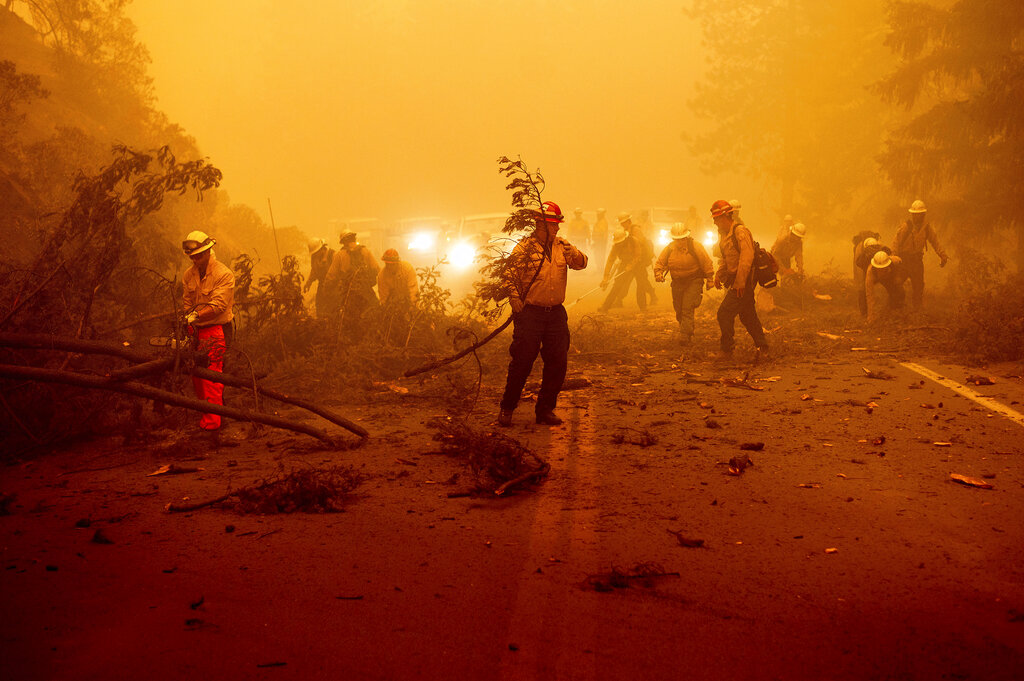
During the peak time of the Olympics, extreme heat, high levels of urbanization and the risk of wildfires will increase ozone levels and particle concentrations. People are still experiencing impacts from the lingering heavy metals in the air from the Eaton and Palisades fires in January 2025.
This means visitors will be subject to smog’s health consequences, ranging from minor lung irritation to coughing and wheezing attacks. If the Olympics were chosen in a city without a history of extreme air pollution, athletes and visitors would not have to put their health in danger to attend.
Transportation will also influence the environment during the Olympics. This international event will span across the entire state, requiring many to use individual transportation to attend events. The city’s notoriously gridlocked traffic — severe traffic congestion— on sprawling highways will only increase smog congestion.
Initiatives to improve LA’s mass transit systems will be crucial to sustaining the quality of LA’s air rather than allowing the high levels of traffic to worsen the air quality. Without improved bus lanes and air taxis to reduce the amount of on-ground emissions, LA will experience extreme traffic congestion and increased air pollution during the Olympics.
Instead of relying on individual vehicle transportation, LA’s Metro bus lines must follow through in carrying out its 15 Olympic projects to make its lines more efficient and accessible to spectators. These projects range from expanding route networks to the Olympic venues to reaching zero bus emissions.
Alternatively, LA’s Olympic Committee has partnered with Archer, an air-taxi service that will transport participants and spectators across the city. These all-electric taxis will be effective in reducing noise and emissions as people travel across venues to take part in the games.
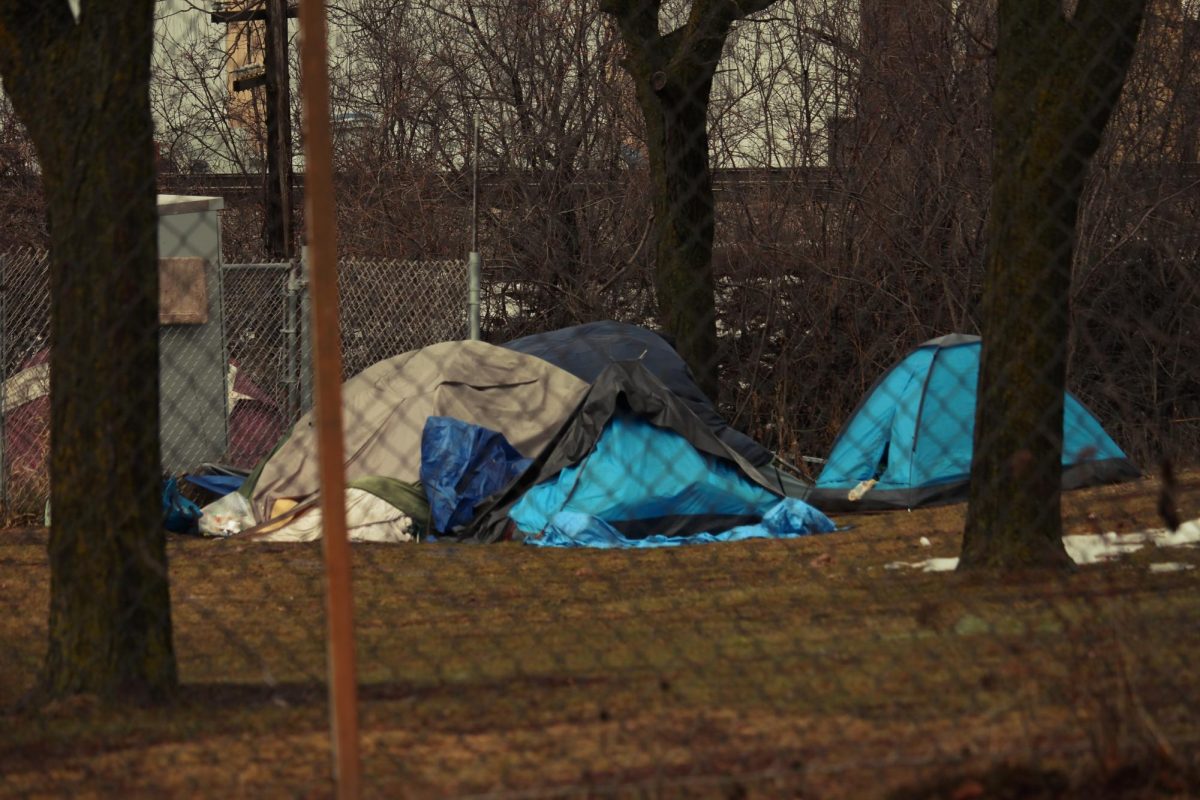
Alongside environmental challenges, LA already struggles to efficiently house its population, and millions of spectators entering the city will only make its dire situation worse. With nearly 72,000 homeless people, the city’s homeless shelters struggle with an overcrowding rate that is four times the national average.
This means unhoused people will have no place to go if displaced by the 2028 Olympics, putting them at risk of health issues, violence and loss of connection to support services.
During the 1984 Olympics, over 30 police officers were deployed to “sanitize the area.” If LA forces unhoused residents to be displaced prior to the 2028 Olympics, the city risks increasing the economic gap between its poorest residents and those able to afford expensive housing costs. In the past year, Gov. Gavin Newsom has urged cities to ban encampments entirely, which is predicted to only intensify the issue of overcrowding and economic disparity as the Olympics approach.
These issues are not unique to LA as a host city. Paris faced similar ones in 2024 when marginalized groups were put at a disadvantage from Olympic-related developments.
Prior to the games, hundreds of squatters and citizens in underprivileged housing were displaced to sanitize central Paris. Additionally, a newly-constructed highway was placed directly next to a local school, exposing children to unsafe levels of pollution. In both cases, Paris authorities failed to address the protests of their citizens, and instead, prioritized the possible economic benefits from hosting the Olympics.
Global attention will shine on LA, but whether this light brought to LA’s Olympic Games will showcase its issues or adaptability will be determined by the city’s measures of preparation in the next two years. The environment and underprivileged populations of LA will face monumental risks from the Olympics being held in this struggling city.
This story was written by Bella Gruber. She can be reached at [email protected].