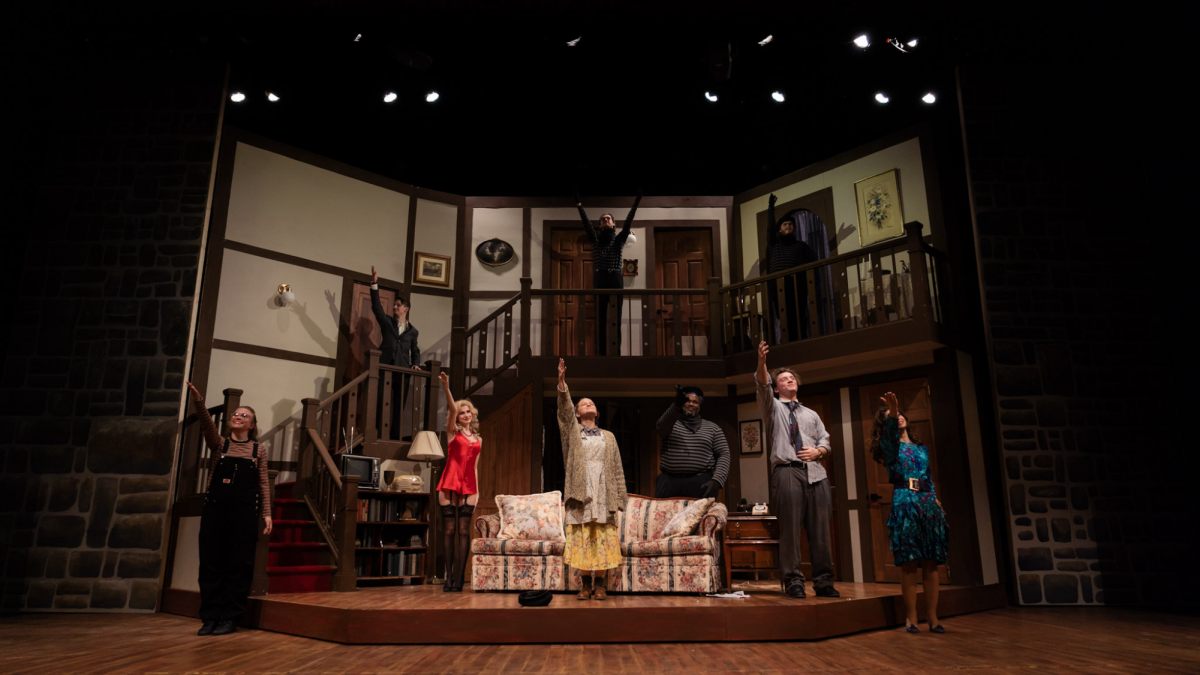


The Marquette University Players Society, a student-led theatre organization, put on its first production of the year, “Fire Exit” on Nov. 17 and 18 in Straz Theater. Originally written by Stacie Lents, this play tackles themes of friendship, guilt and loss, all set in the aftermath of a fire at Westfield High School.
Told in a series of short, mostly humorous monologues, each of the eight characters parses through their emotions after the fire; what they could’ve done differently, who should be held responsible and why something this tragic happened to their community.
The show opens with Principal Evans, played by Jack Del Pizzo, a junior in the College of Arts & Sciences, and seven students sitting in class. Each student falls into the stereotypical archetypes found in most media about high school: the nerd, the jock and the class clown.
Though using archetypes like this can work (I love myself some “The Breakfast Club” or “High School Musical”), I found the use of them here slightly corny. It seemed like the script wasn’t aware of said corniness in the way that other successful portrayals do.
Rudy, played by Josh Zientara, a junior in the Colleges of Arts & Sciences and Communication, introduces himself and his closest friend Jenks, played by Elizabeth “Bets” Draper, a first-year in the Colleges of Education and Communication, to the audience. The two are determined to do whatever they can to get out of class or distract their teacher and even resort to pulling the fire alarm.
One day, however, after the fire alarm is pulled, Rudy is unable to find Jenks. Rudy stays in the building to look for Jenks, son of the fire chief Devin, played by John “JR” Francis, a first-year in the College of Communication. He runs back into the school in an effort to find him, but Jenks doesn’t make it out, resulting in his death.
This part of the show was a stark change in tone from the beginning monologues, which felt like there was a joke, especially from Rudy, every other line. To see the goofy troublemaker running back into a fire in an attempt to save his best friend’s life was certainly jarring.
As the show goes on, each character deals with the death of Jenks differently.
Bobbie, played by Mei Macey, a senior in the College of Health Sciences, who has only missed three total days of school in her life, including the day of the fire, anxiously calculates the survival rate in an attempt to cope with her survivor’s guilt. Helen, played by Carrie DeCoster, a first-year in the College of Arts & Sciences, lists U.S. presidents and her parents’ grocery list to comfort Rudy. Morgan, played by Meghan Brockway, a first-year in the Colleges of Health Sciences and Communication, takes on the role of detective, determined to find the truth about who started the fire.
The only problem with structuring the show in only monologues was that I sometimes felt lost in the story. By not having the characters interact with each other, sometimes telling the story from the present, and other times from the past, I felt like I only knew what was happening by the time the show was halfway over. But maybe this confusion I felt as an audience member was supposed to reflect the confusion the characters were feeling throughout the plot.
With the small cast of eight, I was unsure of how director Kendall Syslack, a sophomore in the College of Communication, was going to make the audience feel the sense of community that she described the show evokes in her introduction speech.
As each monologue went on, however, I got a better sense of each individual who makes up Westfield High School. I felt the entire community’s effort to make sense of this tragedy. In this story, people who would have never spoken before turned to each other for comfort in this loss. I understood that what these characters needed most in their time of struggle was each other.
While I thoroughly enjoyed every actor’s performance, I was particularly struck by Zientara’s and Francis’s portrayals of Rudy and Devin. These characters broke my heart, and both actors masterfully portrayed the misplaced responsibility one takes on in the process of grieving someone.
While the set, consisting of eight chairs facing the right side of the stage, stayed the same for most of the play, the lighting, done by Rory Dwyer, a sophomore in the College of Arts & Sciences, was used to bring the audience to different locations throughout the story. As Rudy and Helen approach the fire, the light turns increasingly red, and then completely black when Rudy passes out. This was a compelling tool that I have rarely ever seen used.
“Fire Exit” is a show about how tragedy tears people down but can also bring them together. While each character lives in the world of their own monologues, they are all connected by this loss. The answer to who started the fire and how to come to terms with Jenks’ death are intertwined with a common theme: things are usually more complicated than they appear.
More information about the Marquette University Players Society can be found on their webpage.
This article was written by Annie Goode. She can be reached at [email protected].