

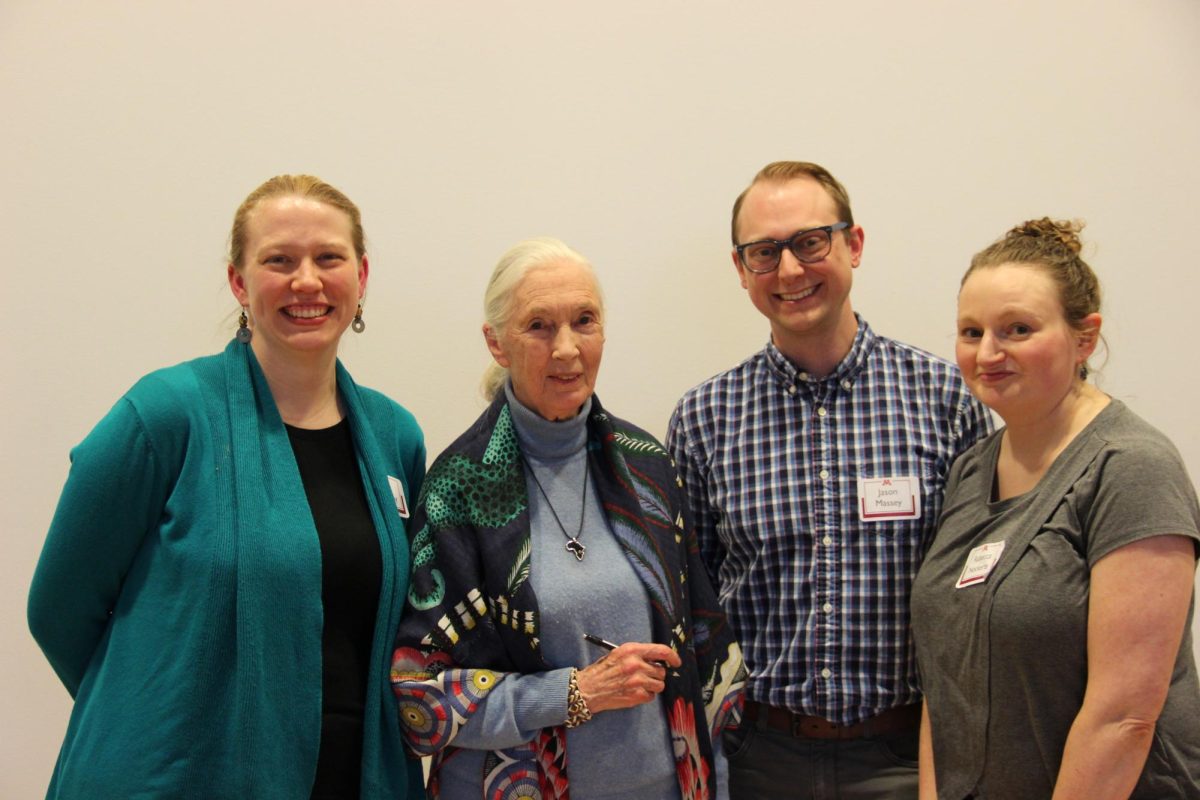
One could say there was always an invisible string tying Marquette biomedical sciences professor Claire Kirchhoff to the late primatologist Jane Goodall.
It spanned nearly 20 years and 8,300 miles, starting in Minneapolis before traveling across the world to Gombe National Park in Tanzania — on a trip to study baboons — and ending with Kirchhoff sitting on Goodall’s couch, a moment that will stick with her forever.
The twine first unwound while she was in college.
Kirchhoff, then a graduate student at the University of Minnesota, briefly met Goodall while she was guest speaking. Also at the school was Mike Wilson, a former research director at Gombe National Park, where Goodall started her groundbreaking research into chimpanzees in the 1960s.
Wilson became a mentor for Kirchhoff, and her emerging interest in primate skeletal research.
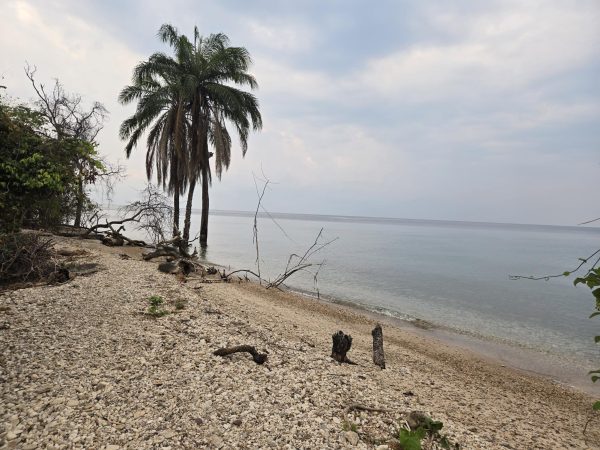
Photo courtesy of Claire Kirchhoff.
“He had some connections for me, and said, ‘There’s this skeletal collection, a portion of it that no one has ever seen before,” Kirchhoff said. “You’re looking for a project about primate skeletons, and wouldn’t this be a priceless opportunity,’ Indeed it was.”
Later in 2008, the string extended across the ocean, when Kirchhoff traveled to Gombe to work on her dissertation about the remains of a baboon named Flo.
On the trip, Wilson showed her to a small research facility and pulled a blue bag off a shelf before passing it to Kirchhoff carefully, like it was a baby. In a way, it was. These were remains of a baboon named Goblin, who Goodall observed from the moment he was born.
“I hope you learn amazing things from him,” Wilson told Kirchhoff.
With that, the true unraveling began.
Through this one interaction, Kirchhoff became part of a network of scientists that dedicate their lives to understanding humanity through generations of chimpanzees.
“It felt like such a surreal moment for me to be part of this huge narrative that’s so much bigger than I am,” Kirchhoff said.
She went to Gombe a second time in 2009. This July, after 16 years away, she was able to return for five weeks.
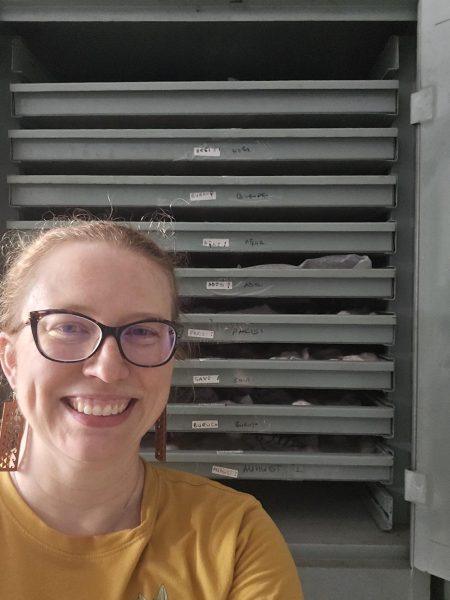
Photo courtesy of Claire Kirchhoff.
Each morning, Kirchhoff would wake up and walk to the lab, lock herself inside and start thinking about the story behind each baboon. She would take inventory of what she was observing and start to piece together the puzzles of their lives.
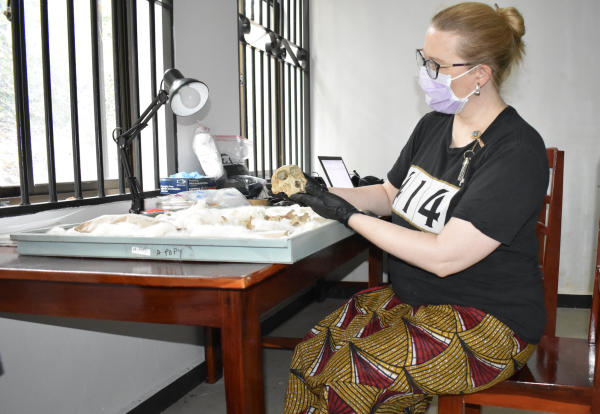
Photo courtesy of Claire Kirchhoff.
After her day’s work, she’d swim in Lake Tanganyika and go to bed — just to wake up and do it all again.
But one day, that routine changed, and the invisible string reached its end.
“[The research director] comes running into the lab and says, ‘Can you come and tell Jane about Flo?'” Kirchhoff recalled.
The chimpanzee — the one Kirchhoff studied for her dissertation about 15 years prior — was among Goodall’s favorites.
Stunned by the invitation, she walked to the house Jane stayed in, which she said had a lived-in feel, with rocks from the beach displayed in the home alongside other natural history mementos that reflected Goodall’s work.
Goodall asked Kirchhoff to sit on her couch and share what she’d learned about Flo over a cup of tea.
So, with her computer on her lap, she told Goodall about Flo’s teeth and the condition of her skeleton, noticing all through the conversation how sharp and vivid Goodall’s memories still were.
But to Kirchhoff, the truly unforgettable moment happened as she was walking out.
“Stay curious,” Goodall told her. “Keep asking questions. Things that are not possible today could be possible in the future and you just never know.”
Now, Kirchhoff carries these words with her, inspired by Goodall’s work every day.
“I feel bolstered and buoyed by her undying hope and deep, deep curiosity and desire to keep growing what we know and understand,” she said.
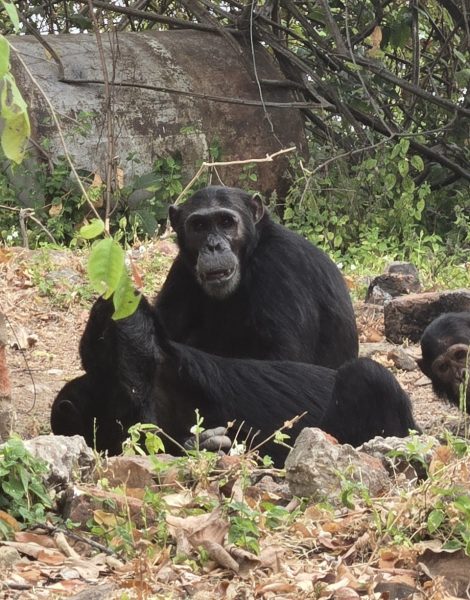
Photo courtesy of Claire Kirchhoff.
When she heard of Goodall’s passing on Oct. 1, Kirchhoff said the loss was “unexpectedly devastating.”
“Part of me wanted to believe she was immortal,” she said.
Kirchhoff said the piece of advice she received from Goodall is now etched into her life’s timeline, acting as a guidepost for her research.
“I will be thinking about that for the rest of my conscious life,” Kirchhoff said. “I think that’s great advice for scientists in general, and for any endeavor that we care about and want to dedicate ourselves to.”
Back in Goodall’s house in Gombe, where everything began decades ago, there sits a hidden door. Goodall installed it herself so she could sneak out at any time to sit in the forest among the creatures that she called her friends and the landscape she deemed her home.
Even after her death, that door stays open.
It invites scientists nationwide to partake in work that wouldn’t be possible without Goodall and her passion. Now, the mission must be passed down to those she’s influenced.
“That’s the torch we’re going to have to pick up now,” Kirchhoff said. “I think we’re going to find it heavy.”
After 91 years of life, Goodall’s work should continue.
Thanks to people like Kirchhoff, it will.
This story was written by Sophia Tiedge. She can be reached at [email protected].
