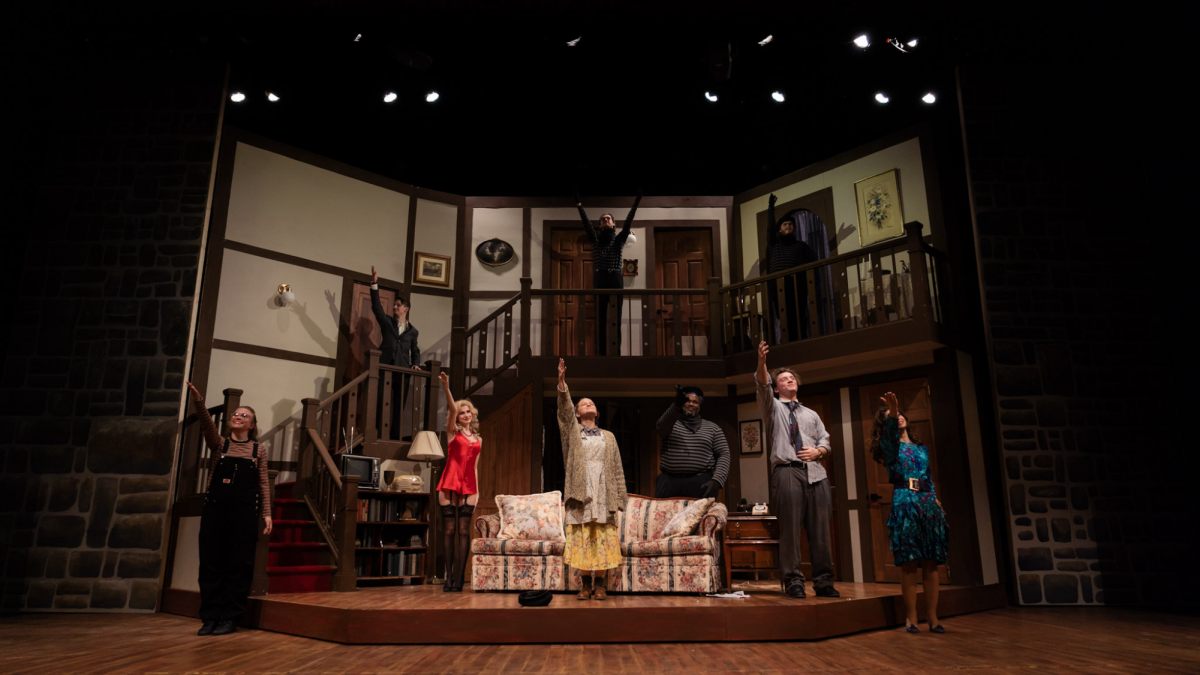


Tucked in the Debra Krajec Studio of Helfear Theatre, Marquette Theatre presented “The Tragedie of Ophelia: Lady of Denmark” on Oct. 5 and 6.
The 50-minute play directed by Jamie Cheatham—professor and head of acting at Marquette—provided an on-campus production for those not in “Fiddler on the Roof”— which is in partnership with Skylight Music Theatre and running until Oct. 26.
Serving as a portion of “Hamlet,” the play highlights Ophelia and her tragedy, rather than treating her as a background love interest. It offers deeper insight into her story, which is often neglected and overlooked by “Hamlet” enthusiasts.
The smaller production consisted of a six-person cast, simple costumes, a minimal set and a few basic lighting changes, allowing the actors and actresses to emphasize their acting over anything else.
Tickets were free to the public, and the show was packed, forcing some audience members to stand during the performance. I arrived 15 minutes early, and I snagged one of the last seats.
Ophelia—played by Erin Cavender, a senior in the College of Communication—and her brother Laertes—played by Elisabeth Draper, a first-year in the School of Education—replicated a sibling banter on stage that many can relate to, drawing laughs from the audience.
Blue lighting then overcame the room as the ghost of Hamlet’s father—played by John “JR” Francis, a first-year in the College of Communication—appeared, making audience members’ heads turn to the back of the room.
Only a crown and cloth covered the ghost’s face, but the simple and effective use of costuming left not only Hamlet—played by Christian Wood, a first-year in the College of Communication—but also the audience members with an eerie feeling of what was to come for Claudius’ fate.
Throughout the show, red lighting would appear when Hamlet went on rampages, demonstrating his anger. Wood’s acting only added to this aspect, as his rage could be seen in his eyes and the veins slightly popping out of his neck with a red flush on his face.
While the show established Hamlet’s character and mental state, I found myself thinking that there was too much time spent establishing Hamlet, considering this was supposed to be about Ophelia’s story. But as the show went on, the focus shifted back to Ophelia.
Polonius—played by Dylan Guiliano, a sophomore in the School of Education—did a fantastic job as Ophelia’s controlling father. Guiliano’s precise mannerisms displayed dominance over Ophelia, especially when he began speaking for her during interactions with Claudius—also played by Francis.
During these interactions, Cavender’s body language spoke volumes about how powerless she felt within her family dynamics.
Ophelia holds true love for Hamlet, but between Laertes and Polonius dominant characters with Hamlet’s erratic behavior, she often finds herself conflicted and torn between staying true to her heart or family lineage.
In these moments when the people around Ophelia discuss her without her input, Cavender is often slightly hunched forward with her arms crossed in front of her body, showing how shy and uncomfortable she feels.
This use of physical acting adds another complexity to her performance that is difficult to achieve, but she perfects it.
Even with her impressive physical acting, Cavender’s performance peaked at the show’s end after she drowned.
She becomes a ghost—replicating a glassy, pale look on her face—carrying red flowers as people mourn at her grave. The lack of emotions on her face shows how numb she became after Hamlet killed her father, and how it continued, even to the moment of her death.
For a short play, all six cast members utilized the minimal set to highlight their acting abilities. They created a compelling story with an untraditional take on “Hamlet,” leaving audience members reconsidering how Ophelia was originally depicted.
This story was written by MaryKate Stepchuk. She can be reached at [email protected].